
How Regional Endpoints Improve API Performance
Speed matters. When your app validates an email, even a tiny delay can frustrate users. Regional endpoints solve this by processing requests closer to the user, cutting latency by 40–70%. They terminate TLS sessions locally and maintain fast, persistent connections, ensuring real-time validation without delay.
Key Takeaways:
- Faster API Responses: Data travels shorter distances, reducing round-trip latency.
- Improved Reliability: Traffic shifts to healthy regions during outages, ensuring uptime.
- Higher Scalability: Each region handles its own traffic, preventing bottlenecks.
- Independent Rate Limits: Separate limits per region avoid global rate-limit issues.
For services like TempMailChecker, this setup means sub-millisecond email validation and better protection against fake signups. By choosing the right regions and optimizing your setup, you can deliver a smoother, faster user experience. Developers can also block disposable emails in signup forms using our ready-to-use code examples.
How to Choose the Right AWS API Gateway REST API Endpoint Type
What Are Regional Endpoints?
Global vs Regional API Endpoints Performance Comparison
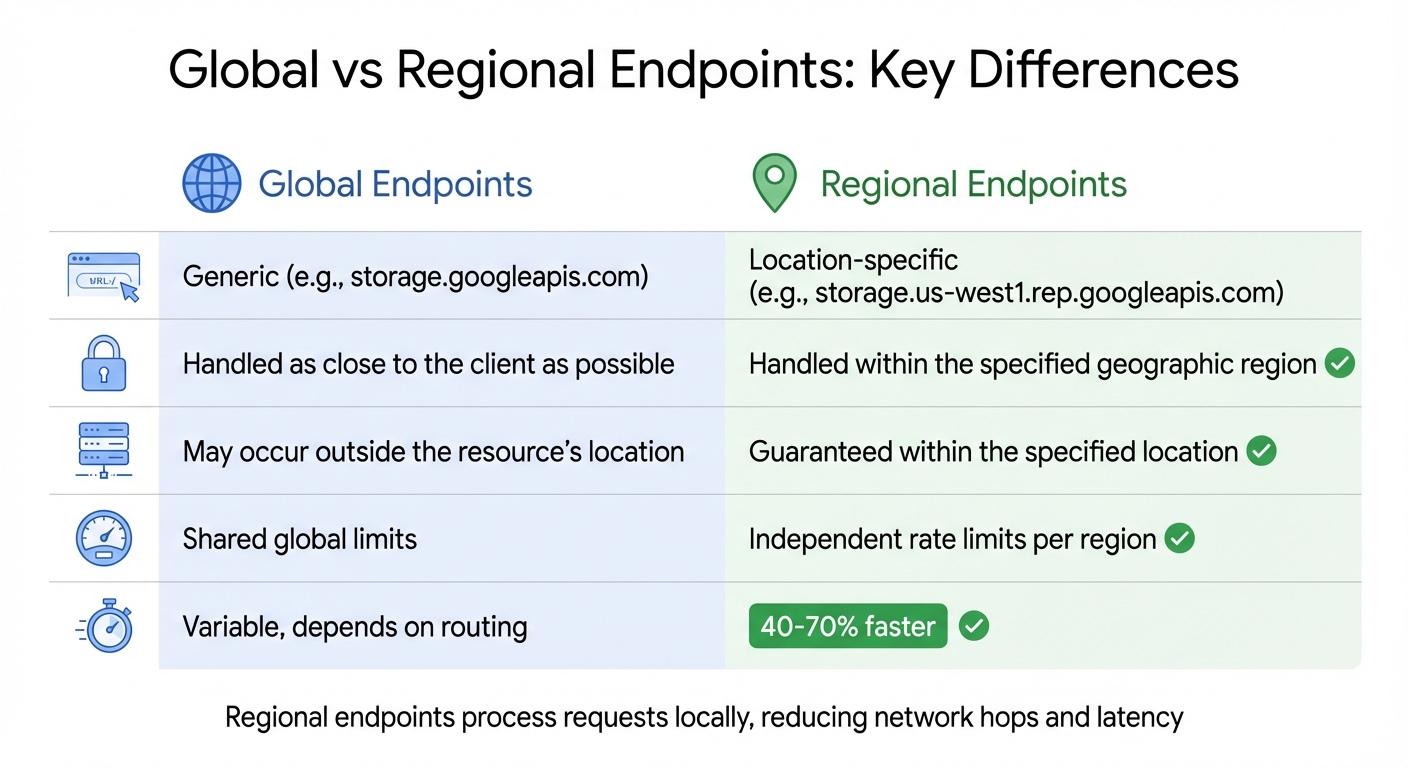
Regional endpoints are API entry points tied to specific geographic locations, such as us-west1.api.service.com. These endpoints ensure that both the connection and TLS termination happen within the designated region. Unlike global endpoints - where a generic address like api.service.com might route requests to various datacenters - regional endpoints strictly process requests within the specified area.
"Regional endpoints guarantee data residency by ensuring that your object's data at rest and in transit does not get moved out of the location specified by the endpoint." – Google Cloud Documentation
For tasks like real-time email validation, this approach offers clear advantages. For instance, regional endpoints reduce network hops and deliver consistent performance. Let’s take a closer look at how they operate.
How Regional Endpoints Work
Regional endpoints handle API requests entirely within the boundaries of the specified region, cutting out unnecessary network travel. When your application sends a validation request to a regional endpoint, everything - from the initial handshake to the final response - happens locally. This direct routing avoids the latency caused by detours through distant locations.
To put it into perspective, every 100 kilometers (about 62 miles) of travel adds roughly 1 millisecond of round-trip latency. However, actual network paths are often 1.5 to 2 times longer than the straight-line distance. Regional endpoints reduce this inefficiency by keeping traffic within the region.
Persistent connections also benefit from this setup. By localizing connections, regional endpoints eliminate the "handshake tax" associated with establishing new connections over long distances. For tasks like disposable email detection during user signups, this means validation checks are completed in milliseconds, avoiding delays that could frustrate users.
Modern networks typically add 1–10 milliseconds of latency to reach an ISP, while 3G cellular networks can introduce delays of 100–500 milliseconds. Regional endpoints minimize controllable latency, ensuring response times remain within acceptable limits even under challenging network conditions.
Why Regional Endpoints Matter for Real-Time Email Detection
The efficiency of regional endpoints directly impacts real-time email validation, a critical part of user signup workflows. Any delay during signup can lead to user frustration and higher abandonment rates. Regional endpoints ensure that disposable email detection happens close to your application server, providing a seamless, sub-second experience.
Another benefit is their independent rate limits. Unlike global endpoints, where rate limits are shared across all users, regional endpoints often have separate limits for each geographic area. This prevents rate-limit errors in one region from affecting API performance elsewhere, ensuring reliable service across different markets.
| Feature | Global Endpoints | Regional Endpoints |
|---|---|---|
| URL Structure | Generic (e.g., storage.googleapis.com) |
Location-specific (e.g., storage.us-west1.rep.googleapis.com) |
| TLS Termination | Handled as close to the client as possible | Handled within the specified geographic region |
| Data Processing | May occur outside the resource's location | Guaranteed within the specified location |
| Throttling | Shared global limits | Independent rate limits per region |
For services like TempMailChecker, this architecture enables fast, region-specific validation, ensuring high performance while combating fake signups across its database of over 277,938 disposable domains.
How Regional Endpoints Improve API Performance
Regional endpoints bring three key benefits to APIs used for disposable email detection: faster response times, improved reliability, and greater scalability. These advantages help your application validate email addresses efficiently during user signups, reducing delays and blocking fake accounts.
Lower Latency
When API servers are located near your users, response times drop significantly. For example, a U.S.-based app connecting to a U.S. regional endpoint avoids the delays of transcontinental data travel. Physical distance directly impacts speed - requests traveling from Seattle to Dublin, for instance, can take around 170 milliseconds for a round trip.
Optimized regional endpoints can process disposable email detection requests in under 50 milliseconds from major global regions. This rapid response is crucial during real-time signup validation, where delays can frustrate users and lead to abandoned registrations. TempMailChecker’s regional infrastructure ensures email validation against its database of 277,938+ disposable domains happens close to your application server, maintaining consistent speed no matter where your users are.
But speed isn’t the only advantage - regional endpoints also enhance system reliability, as explained below.
Better Reliability and Failover
Regional endpoints don’t just improve speed; they also make your API integration more reliable. By routing traffic through multiple regions, they protect against outages. If one data center encounters an issue, traffic automatically shifts to healthy regions without requiring manual intervention. This setup ensures 99.99% uptime with fully load-balanced infrastructure across multiple locations.
"If either region experiences an impairment, SES will automatically shift traffic away from the affected region to maintain continuity of your sending operations." – Amazon Simple Email Service Documentation
Continuous health checks monitor endpoint performance. If a primary region fails, DNS servers seamlessly redirect requests to the nearest operational location. This process is invisible to users, so email validation continues without interruptions. Additionally, regional endpoints help mitigate DDoS attacks by isolating and monitoring traffic at the regional level.
With reliability covered, let’s look at how regional endpoints handle heavy traffic loads.
Increased Throughput and Scalability
Spreading API traffic across multiple regions ensures no single server becomes overwhelmed. By distributing the load, regional endpoints provide the capacity needed to handle high-demand scenarios.
Top-tier email validation APIs leveraging regional infrastructure can support 220 transactions per second (TPS) or more. During traffic surges, requests are automatically routed to secondary regions with available capacity. This is especially important for businesses facing signup spikes, as 20% of signups on some platforms come from disposable email addresses. Managing this volume in real time requires infrastructure that can scale effectively.
Each region scales independently, preventing bottlenecks and ensuring smooth performance even during peak signup periods.
sbb-itb-cfbd9fd
How to Implement Regional Endpoints in Your API Integration
Now that you understand the advantages of regional endpoints, you can integrate them into your API setup to improve real-time email validation. The process involves selecting the right regions, configuring your application, and fine-tuning performance for the best results.
Choosing the Right Regional Endpoints
Start by identifying where your users are located. For example, if most of your traffic comes from the U.S., consider regions like US East (N. Virginia), US East (Ohio), or US West (Oregon). For West Coast users, Oregon is a great option to reduce latency.
To ensure users are routed to the fastest available region, implement latency-based routing through your DNS provider. This approach automatically directs traffic to the region with the quickest response time. If your application serves users in Europe, be mindful of regulations like GDPR, which may require you to use EU-specific endpoints to keep data within European data centers.
Testing is key. Use tools like regional checker APIs to measure metrics such as DNS resolution, TLS handshake times, and Time to First Byte (TTFB) across different regions. This data helps you pinpoint which endpoints deliver the best performance for your user base.
Once you've identified the ideal regions, the next step is to configure your application to use them effectively.
Setting Up Your Application
After selecting your regions, configure your app to work seamlessly with the corresponding endpoints. Use environment-specific base URLs, such as API_ENDPOINT_OVERRIDE, to set up targeted endpoints. For instance, you could configure production to use https://api-us-east.tempmailchecker.com and assign a different region for staging.
If you plan to use multiple regions for failover, ensure that your configuration is synchronized across all locations. This includes replicating verified identities, API keys, and settings in each region to avoid disruptions during failover events. Amazon SES provides this guidance:
"It's recommended that you request the maximum quota you're eligible for in both regions. While email traffic is distributed amongst both regions under normal operating conditions, during a failover event, the full volume of email traffic will be sent to one region and its limits should be enough to handle the full volume load."
By aligning configurations across regions, you set the stage for smoother performance and reliability.
Optimization Techniques
Consider using VPC endpoints to keep API traffic within your provider's network. This approach not only boosts security but also improves performance without adding extra costs.
Monitoring and Optimizing Regional Endpoint Performance
Once regional endpoints are in place, it's crucial to keep an eye on performance metrics to ensure quick response times. Breaking down these metrics by region can help identify localized issues that might not be obvious when looking at global averages.
Tracking Performance Metrics
When monitoring performance, focus on percentile response times rather than just averages. For instance, you might aim for an average response time under 500 ms, but also ensure that the 95th percentile stays below 2.0 seconds. Keep an eye on requests per second (RPS) in each region to spot sudden plateaus, which could signal scalability issues. Additionally, track HTTP 4xx/5xx errors and connection resets by region to pinpoint problems specific to certain endpoints. To stay ahead of potential issues, use synthetic monitoring with scheduled requests and conduct soak testing under sustained traffic to detect gradual resource leaks.
Load Testing Regional Endpoints
To validate your regional setup under realistic conditions, use a mix of load tests. These include:
- Baseline testing to establish normal performance benchmarks.
- Spike testing to simulate sudden traffic surges.
- Stress testing to find breaking points.
- Soak testing to uncover resource leaks over time.
For accurate results, simulate traffic from your users' regions to reflect actual latency conditions. Modern cloud testing tools make it easy to allocate specific loads from different regions, while TCP-based tools provide a more accurate picture of application traffic compared to tools like ping. These testing methods ensure your regional endpoints deliver optimal performance in real-world scenarios.
Using TempMailChecker for Real-Time Validation
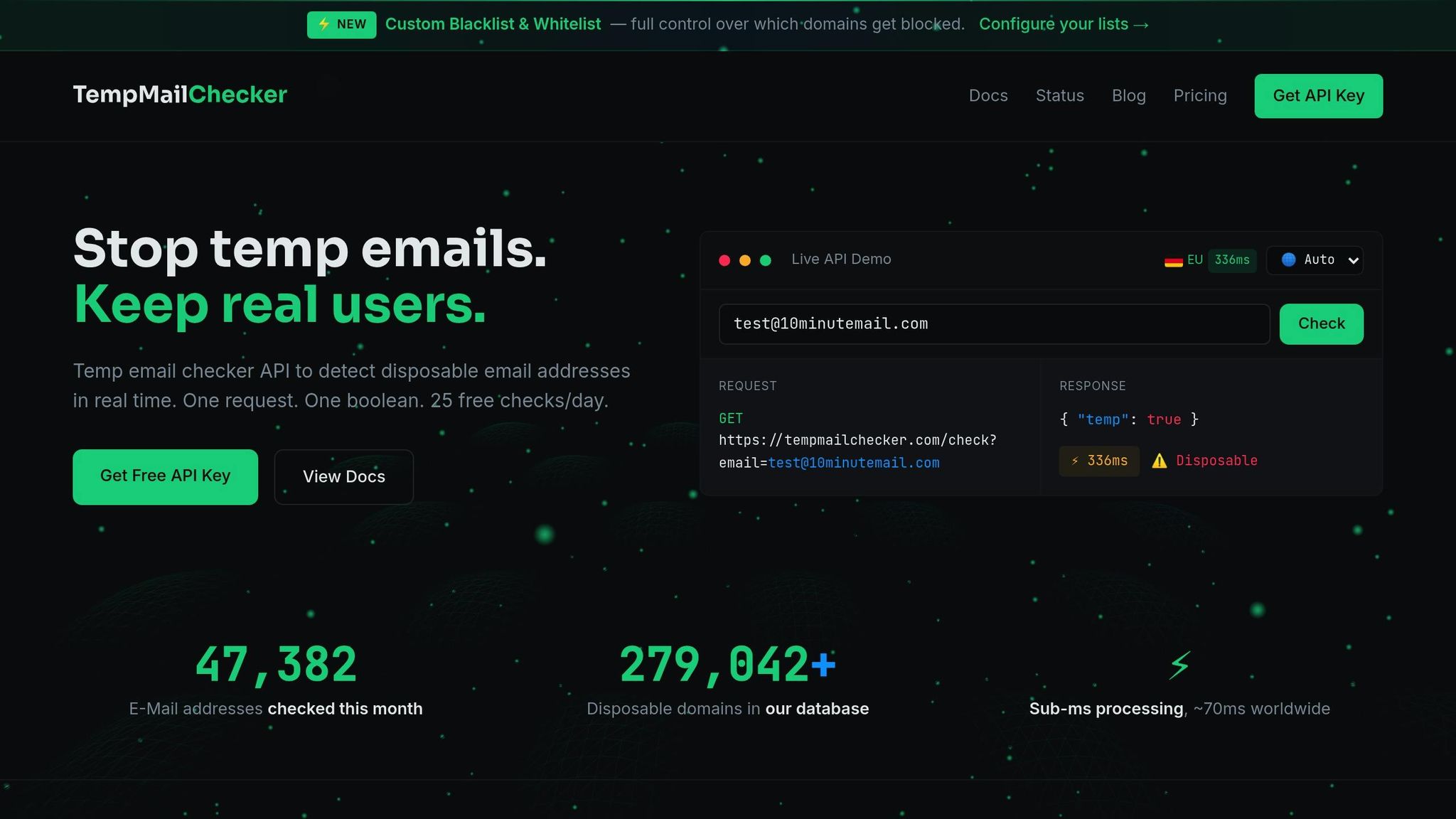
TempMailChecker offers a great example of how regional endpoints can enhance real-time validation. By strategically placing its regional endpoints, the service achieves sub-millisecond response times, enabling rapid detection of disposable emails for both U.S. and international users. TempMailChecker delivers precise, real-time email validation without sacrificing speed. Its pricing plans, ranging from free to enterprise-level, include access to regional endpoints, making it a flexible solution for varying traffic needs.
Conclusion
Placing servers closer to users through regional endpoints can slash API latency by 40–70% compared to single-region setups - a game-changer for real-time email validation. This boost in speed ensures smooth and efficient user signups.
But it’s not just about speed. Regional endpoints also deliver geographic redundancy, which adds a layer of reliability. If one datacenter experiences an outage, traffic is automatically redirected to the nearest active region, ensuring uninterrupted service even during regional disruptions. For businesses managing sensitive data, these endpoints also address data residency requirements, keeping email validation requests within specific jurisdictions to meet compliance standards.
TempMailChecker leverages this approach by deploying regional endpoints strategically, enabling lightning-fast email validation for users in the U.S. and across the globe. With access to an extensive disposable domain database, the platform blocks fake signups in real time without sacrificing speed. Plus, regional endpoint access is included across all pricing tiers, ensuring high-performance validation for businesses of any size.
FAQs
How do regional endpoints help improve API performance?
Regional endpoints enhance API performance by directing requests to the nearest data center or edge location. This approach cuts down the distance your data needs to travel, eases network congestion, and eliminates unnecessary cross-region traffic.
By streamlining the network path, regional endpoints can dramatically reduce API latency - often achieving a 40–70% improvement compared to relying on a single global endpoint. The result? Faster responses and a more seamless real-time experience for users.
How do independent rate limits for regional endpoints enhance API performance?
Independent rate limits for regional endpoints give you the flexibility to manage traffic on a per-region basis, instead of applying a single global cap. This setup ensures that a sudden surge in traffic - or even malicious activity - in one region won’t disrupt the API’s availability or performance in other areas. By isolating these limits, you maintain steady service while keeping localized issues contained.
This strategy also boosts efficiency by routing requests to the closest data center, cutting down on latency and adhering to data-residency rules. Plus, with region-specific limits, you can allocate more resources to high-traffic regions while keeping stricter limits in areas with lower usage. The outcome? A faster, more dependable API that excels at handling real-time disposable email detection, even during spikes in regional traffic.
How do I select the best regional endpoints for my application?
To find the best regional endpoint for your API, start by pinpointing where the majority of your users are located. If most requests come from a specific region, opting for a regional API endpoint can significantly improve response times by keeping traffic local. This not only cuts down on latency but also helps address data residency and compliance requirements.
For applications with a user base spread across multiple regions, you can still ensure great performance by combining regional endpoints with a content delivery network (CDN). This pairing keeps latency low and delivers fast responses on a global scale. Running latency tests and monitoring performance from key user locations can help verify that your setup achieves the desired results.
Don’t overlook operational considerations like cost and scalability. Regional endpoints are often more budget-friendly since they avoid the extra fees tied to edge-optimized APIs. For enhanced availability, you can deploy your API across multiple regions and use routing strategies to direct users to the closest endpoint. By aligning endpoint selection with your users’ locations and performance expectations, you can ensure TempMailChecker’s disposable email detection API is both fast and reliable.