Best APIs for Disposable Email Detection
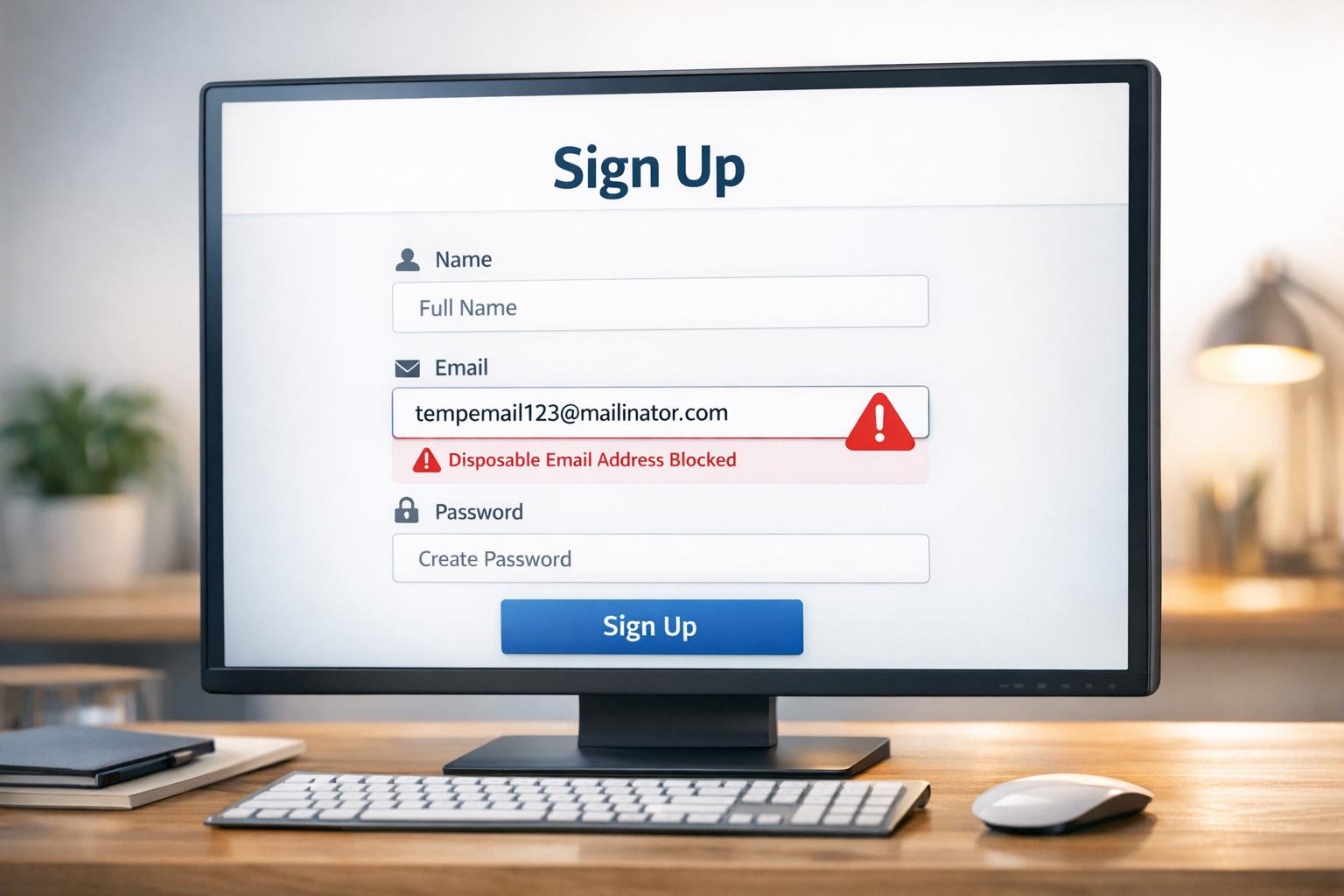
Disposable email addresses are a major issue for businesses, causing fake signups, spam accounts, and skewed metrics. Over 20% of signups on some platforms come from these temporary emails, which can harm sender reputation and inflate databases with invalid users. To tackle this, APIs for detecting disposable emails offer real-time solutions to block these addresses at critical points like registrations and transactions.
Here’s what matters when choosing a disposable email detection API:
- Accuracy: Look for APIs with frequent updates to their disposable domain databases and advanced checks like MX-record lookups and SMTP verification.
- Speed: Real-time validation should respond in under a second, balancing speed and thoroughness.
- Integration: REST APIs with JSON responses, clear documentation, and multi-language support make implementation easier.
- Privacy & Security: APIs must comply with GDPR/CCPA, use encryption, and have transparent data policies.
- Pricing: Transparent plans with free tiers and scalable options are ideal for testing and production.
TempMailChecker stands out with its fast response times, tracking over 277,000 disposable domains, and regional endpoints for low latency. It’s developer-friendly with robust SDKs, usage tracking, and flexible pricing starting at $12/month. This API is a practical tool for preventing fraud, spam, and fake accounts in real-time.
How Does Email Validation Detect Temporary Email Addresses? - TheEmailToolbox.com
How to Evaluate Disposable Email Detection APIs
Picking the right disposable email detection API is crucial. A poor choice can lead to security risks, bad user experiences, or wasted development time. Here's a breakdown of what to focus on when evaluating your options.
Detection Accuracy and Domain Coverage
Top-tier APIs constantly update their databases of disposable domains and use advanced analysis methods to tackle new threats. These solutions often detect obfuscation techniques, such as rotating domains, IP addresses, or MX servers.
For better accuracy, look for APIs that layer their verification processes. This includes syntax checks based on RFC standards, MX-record lookups, and real-time SMTP verification to confirm mailbox existence. More advanced systems even use heuristics to flag usernames and domains that appear random or nonsensical.
Domain intelligence is another key feature. By analyzing WHOIS data for domain age or checking for "catch-all" configurations, you can differentiate between legitimate business domains and short-lived disposable ones. Some APIs also tap into global threat networks to identify email addresses linked to suspicious activity, such as chargebacks or fake sign-ups.
"Our disposable domain blocklists are updated multiple times per hour with new services that provide temporary emails so you can quickly blocklist new threats." - IPQualityScore
Real-time checks are a must. Static lists alone won't catch burner emails from private or newly created disposable services, which are increasingly common.
Performance and Latency
For real-time validation, APIs need to deliver responses in under a second without sacrificing thoroughness. This is especially important for high-traffic applications that process large volumes of transactions.
However, there’s often a trade-off between speed and depth. Features like SMTP and catch-all detection can slow down response times. Some APIs address this by offering a "fast" mode that prioritizes speed with shorter timeouts, making it ideal for real-time scenarios. For batch processing or back-end tasks, more comprehensive verification options may be better. Implementing queuing systems can also help manage rate limits effectively.
Ease of Integration and Developer Experience
Modern APIs should be REST-based and return simple JSON responses, making integration seamless across languages like Node.js, Python, PHP, and .NET. The best providers back this up with native client libraries, clear documentation, code samples, and sandbox environments to streamline development.
Features like CORS support and detailed error codes (e.g., 400 for bad requests, 429 for rate limits) further simplify integration. Monitoring for errors like 429 and adding rate-limiting logic can help manage traffic spikes. Some APIs even include execution time metrics to help you assess their impact on performance.
Security and Privacy Standards
Since email addresses are considered personal data, it’s essential for APIs to comply with regulations such as GDPR and CCPA. Leading providers use robust security measures, including 256-bit AES encryption for stored data and HTTPS for data in transit. Secure API key-based authentication is standard, with some providers offering options to rotate credentials if needed.
Check for transparent data retention policies to ensure compliance, especially for enterprise use. Providers should clearly address GDPR and data processing agreements in their documentation. Additionally, features like rate limiting and real-time status monitors help ensure reliability in production environments.
"Detecting disposable emails at the point of entry helps you maintain a clean and reliable contact list while protecting your sender reputation." - DeBounce
Pricing and Reliability
Transparent pricing models with free tiers make it easier to test APIs before committing. For large-scale applications, enterprise-grade APIs often guarantee uptime above 99.99% with SLAs and fail-over systems. Many providers also offer numeric quality scores - on scales like 0 to 1 or 0 to 10 - allowing you to automate decisions for risky sign-ups by setting custom thresholds based on your needs.
TempMailChecker: High-Performance Disposable Email Detection
TempMailChecker API Pricing Plans Comparison for U.S. Businesses
TempMailChecker stands out as one of the fastest and most comprehensive APIs for detecting disposable email addresses. With its speed and extensive domain coverage, it offers a reliable solution for businesses aiming to identify and block temporary email usage.
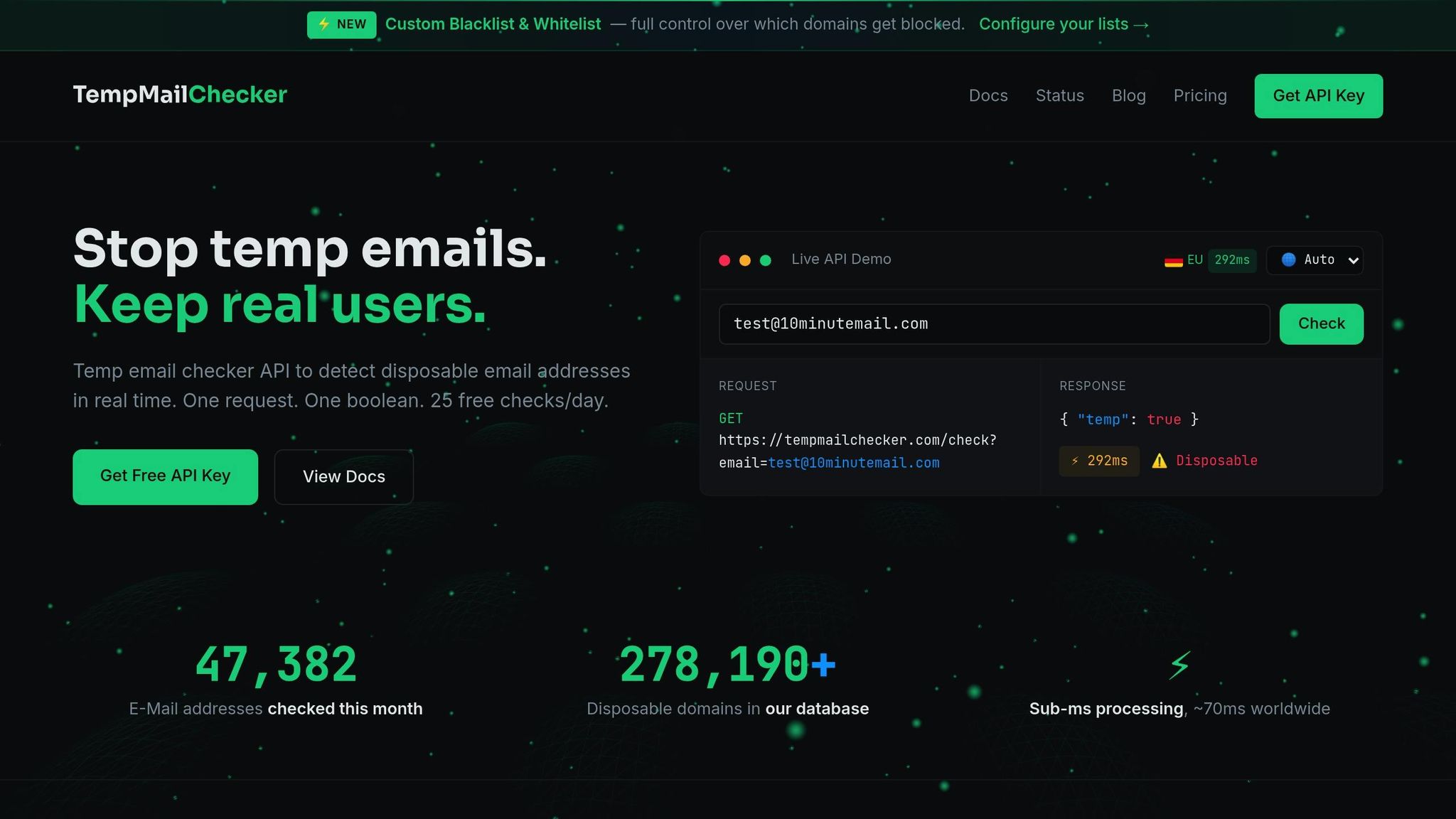
TempMailChecker processes queries in under a millisecond, relying on a database that tracks over 277,938 disposable domains, updated daily. This real-time approach ensures new temporary email providers are detected as they emerge, overcoming the limitations of static lists.
Core Features and Capabilities
The service offers regional endpoints to optimize response times. Depending on the user's location, requests can be routed through EndpointUS for the Americas, EndpointEU for Europe, Africa, and the Middle East, or EndpointAsia for the Asia-Pacific region. This geographic distribution ensures low latency no matter where users are based.
TempMailChecker also includes built-in usage tracking, providing daily reports on usage statistics, rate limits, and reset times. The API delivers simple JSON responses, with a temp boolean indicating whether an email address is disposable - eliminating the need for complex processing.
Integration and Developer-Friendly Design
Designed with developers in mind, the REST API supports any language capable of making HTTP requests, such as Node.js, Python, PHP, and .NET. For Go developers, there’s a native SDK available on GitHub, which comes with no external dependencies. The SDK includes robust error handling to distinguish between issues like rate limits, API errors, and validation problems.
Convenience methods such as IsDisposable allow for quick checks, while CheckDomain enables validation of entire domains. Developers can also use the WithEndpoint function (e.g., tempmailchecker.WithEndpoint(tempmailchecker.EndpointUS)) to align the API with their server's region, reducing network latency and boosting performance.
This streamlined integration makes it easy to implement TempMailChecker into fraud prevention workflows with minimal effort.
Fraud Prevention Use Cases
TempMailChecker proves valuable in scenarios like signup forms, email updates, and payment workflows. For e-commerce platforms, it helps prevent promo abuse by blocking users who create multiple accounts with disposable emails. SaaS companies can also use it to identify users attempting to bypass subscription limits during free trials. Thanks to its speed, the API supports real-time validation, allowing risk scoring systems to incorporate the temp boolean alongside other fraud indicators. This layered approach strengthens defenses against fake accounts and fraudulent transactions.
Pricing Plans for U.S. Businesses
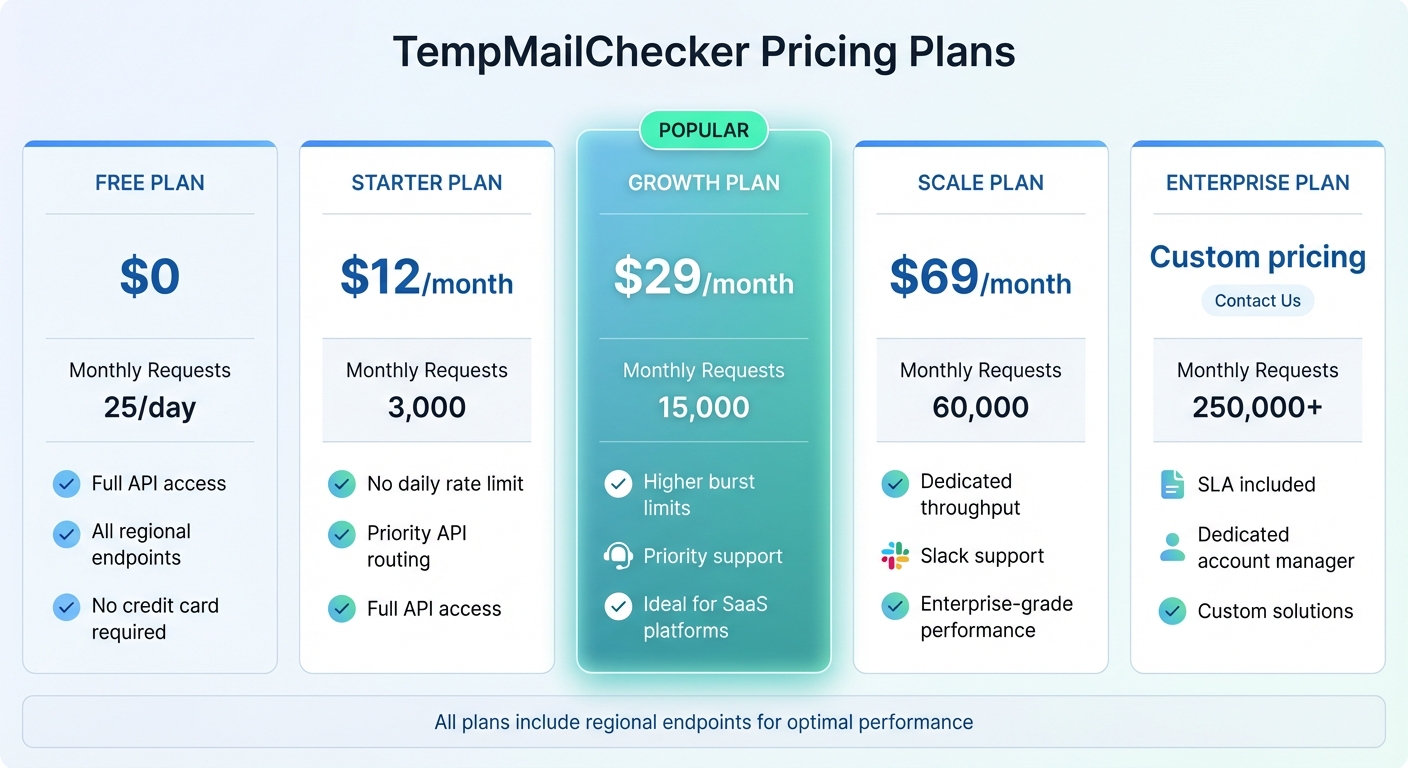
| Plan | Price | Monthly Requests | Features |
|---|---|---|---|
| Free | $0 | 25/day | Full API access, all regional endpoints |
| Starter | $12/mo | 3,000 | No daily rate limit, priority API routing |
| Growth | $29/mo | 15,000 | Higher burst limits, priority support |
| Scale | $69/mo | 60,000 | Dedicated throughput, Slack support |
| Enterprise | Custom | 250,000+ | SLA and dedicated account manager |
The Free plan, with 25 requests per day, is perfect for testing or small projects and doesn’t require a credit card. For production environments, pricing starts at $12/month. The Growth plan at $29/month is an excellent choice for SaaS platforms and marketplaces, while high-volume users can opt for Enterprise plans, which include service-level agreements and dedicated support.
sbb-itb-cfbd9fd
How to Implement Disposable Email Detection APIs
Incorporating disposable email detection into your processes is a key step in combating fraud and ensuring the integrity of your data. Here’s how you can effectively implement these APIs.
Where to Integrate API Checks
The best places to integrate email detection are at critical user interaction points, such as registration forms, checkout pages, and contact forms. By using secure server-side SDKs, you can block fake accounts before they even make it into your database. Real-time validation is especially helpful here - it lets users correct their email addresses immediately, maintaining data quality. For high-value transactions, consider using more thorough verification processes, while quicker checks can suffice for low-risk forms.
These integration points not only enhance security but also help balance user experience and manage false positives effectively.
Managing False Positives and User Experience
To maintain a smooth experience for legitimate users, implement a fail-open logic. This means that if the API encounters an error or times out, the system allows registration but logs the event for later review. You can also use the API's fraud or trust scores to set thresholds for approval - such as automatically approving scores above 0.65. When a disposable email is detected, provide clear and user-friendly feedback, like: "Disposable email addresses are not allowed".
Error Handling and Data Privacy Practices
Error handling and data privacy are essential components of a successful implementation.
- Set API Timeouts: For real-time forms, set timeouts between 1 and 7 seconds to avoid user frustration.
- Monitor for Errors: Keep an eye out for HTTP 429 (rate limit reached) errors and use strategies like exponential backoff or request queuing.
- Use Regional Endpoints: This helps reduce latency and improves performance.
Here’s a quick reference for handling common API errors:
| Error Type | HTTP Code | Recommended Action |
|---|---|---|
| Rate Limit Reached | 429 | Use exponential backoff or request queuing. |
| Unauthorized | 401 | Verify the API key and notify the administrator. |
| Usage Limit Exceeded | 403 | Trigger an alert to upgrade your plan. |
| Internal Server Error | 500 | Allow the process to continue and log the error. |
When it comes to data privacy, always prioritize security. Use 256-bit HTTPS encryption for all data transfers. Avoid storing plain-text email addresses - hash them using methods like MD5 or SHA256. Additionally, choose API providers that meet high standards, such as ISO 27001 certification, and comply with U.S. data protection regulations.
Conclusion
Choosing the right disposable email detection API is crucial for protecting your business and streamlining user registration. The best options strike a balance between high detection accuracy, frequently updated lists of disposable domains, and low-latency performance - ideally under 0.5 seconds. On top of that, seamless integration into your existing systems ensures your registration process stays smooth and efficient.
TempMailChecker stands out by excelling in all these areas. With its advanced detection technology and an easy-to-use REST API, it integrates effortlessly across platforms. It offers real-time protection at critical points like user registration and checkout, effectively keeping fake accounts out of your system.
FAQs
How can a disposable email detection API improve the quality of your data?
A disposable email detection API plays a crucial role in keeping your data accurate and dependable by spotting and filtering out temporary or risky email addresses in real time. This means your email lists are filled with genuine, long-term addresses, which helps lower bounce rates and protects your sender reputation.
By preventing fake signups and automated misuse, this API ensures your database is filled with real users rather than bots or fraudulent entries. The result? More precise marketing campaigns, smarter customer segmentation, and reduced costs tied to cleaning or re-validating email lists. This improves the quality of your data and boosts the efficiency of your business operations.
What features should you prioritize in a disposable email detection API?
When selecting a disposable email detection API, focus on three key factors: real-time validation, simple integration, and reliable accuracy. The ideal API should swiftly detect disposable email addresses and provide a straightforward response - something like a Boolean value (disposable: true/false) to enable quick decision-making. Bonus points if it offers extra details, such as domain type or confidence scores, for deeper insights.
Key features to look for include lightning-fast response times, a frequently updated database of disposable domains, and a developer-friendly interface. Authentication should be straightforward, typically handled via an API key, and the service should support SDKs or libraries for popular programming languages to simplify the integration process. A consistent response format, such as JSON, ensures smooth compatibility with various systems and makes implementation hassle-free.
How can businesses easily integrate a disposable email detection API into their systems?
To integrate the TempMailChecker API into your project, here’s what you need to do:
- Get an API key: Start by signing up on the TempMailChecker portal. Once registered, you’ll receive a unique API key for authentication.
-
Install the SDK: Add the TempMailChecker SDK to your project in the programming language of your choice:
- For Python: Run
pip install tempmailchecker - For PHP: Use
composer require tempmailchecker/php-sdk
- For Python: Run
-
Use the API: Initialize the SDK with your API key, then use the
is_disposable()method to verify email addresses instantly.
The API is designed to detect disposable email domains with lightning-fast response times, often in sub-milliseconds. It’s perfect for blocking fake signups, reducing spam, and preventing fraudulent activities. Plus, its lightweight JSON responses make integration seamless without slowing down your application. This tool helps businesses maintain a trustworthy and reliable user base effortlessly.