Disposable Email Detection: API vs Manual Verification
Disposable email detection is critical for businesses to maintain clean email lists and protect their operations. Two common methods are API-based detection and manual verification. Here's a quick breakdown:
- API Detection: Automated, fast, and accurate. It uses advanced checks like syntax validation, domain analysis, and real-time database updates.
- Manual Verification: Relies on basic checks like syntax review and domain lookups. It's slower, less accurate, and impractical for large-scale tasks.
Key Insights:
- APIs process thousands of emails in minutes, while manual methods take hours or days.
- APIs maintain up-to-date databases, ensuring higher accuracy (up to 98.9%).
- Manual methods struggle with new disposable domains and are labor-intensive.
- APIs are cost-effective for scaling businesses, while manual efforts increase costs with volume.
Quick Comparison:
| Factor | API Detection | Manual Verification |
|---|---|---|
| Speed | Milliseconds per check | Hours to days |
| Accuracy | 98.5%–98.9% | Lower, depends on outdated lists |
| Scalability | Easily handles large volumes | Not practical for scaling |
| Cost | Predictable subscription plans | Labor costs increase with volume |
For growing businesses, API-based detection is the smarter choice, offering real-time validation and scalability. Manual verification may work for small-scale needs or occasional audits but falls short for high-volume operations.

API vs Manual Email Verification: Speed, Accuracy, and Cost Comparison
How API-Based Detection Works
How Detection APIs Function
Detection APIs operate at lightning speed, performing multiple checks within milliseconds. They start by validating syntax, verifying domains, and conducting MX record lookups to ensure the email infrastructure is legitimate. These systems then cross-reference domains against databases of disposable email providers, perform SMTP verification, and analyze WHOIS and DNS configurations. By combining rule-based logic with machine learning models, APIs deliver a layered approach to ensure reliable, real-time email validation.
Advantages of Using an API
Once these validations are complete, the benefits of using APIs become clear. They achieve impressive accuracy rates, often between 98.5% and 98.9%. Unlike manual verification methods that require continuous human effort, APIs can scale effortlessly to process thousands - or even millions - of requests as your business expands. This scalability not only saves time but also reduces costs by automating labor-intensive tasks.
APIs also catch threats that manual checks often overlook, such as spam traps, catch-all domains, and role-based inboxes. These issues can harm your sender reputation, but tools like TempMailChecker's API handle these checks automatically. This ensures your marketing campaigns are targeted at valid, engaged recipients, maximizing the return on your investment.
Integration and Common Use Cases
Beyond their technical capabilities, APIs are easy to integrate. Simply obtain an API key, send HTTP requests with the email you want to validate, and parse the JSON or XML response. This straightforward process works seamlessly with platforms like Salesforce, HubSpot, and Mailchimp.
APIs are widely used across industries. SaaS companies validate signups in real time, e-commerce platforms reduce the risk of failed deliveries, and financial services providers enhance fraud prevention while adhering to compliance standards. For U.S. businesses managing sensitive customer data, APIs offering GDPR compliance and SOC 2-certified security audits are a popular choice, reflecting a commitment to robust data protection.
How Manual Verification Works
Manual Verification Methods
Manual verification relies on straightforward checks rather than advanced technology. Start by examining the email's structure - make sure it has an "@" symbol, a valid domain, and appropriate characters. Then, cross-check the domain against public lists of disposable email providers and use command-line tools to validate MX records, ensuring the domain has legitimate mail servers. You can also look for signs of temporary use, like random strings of characters or keywords such as "temp" or "throwaway." While these methods are simple and easy to access, they come with notable limitations.
Drawbacks of Manual Verification
As your email list grows, manual verification becomes a daunting and time-consuming process. One major challenge is the constant emergence of new disposable email domains, making it nearly impossible to keep track manually. On top of that, technical methods like SMTP VRFY commands or broken SMTP handshakes are often unreliable and can even lead to IP blocks, as mail servers may interpret these actions as suspicious. Manual verification also struggles with more complex issues, such as identifying spam traps, catch-all domains, and heuristic filtering - all of which are crucial for maintaining sender reputation and ensuring email deliverability. While manual methods have their place, they fall short in handling these advanced challenges.
When Manual Verification Still Works
Despite its shortcomings, manual verification can still be useful in specific situations. For instance, small U.S. businesses with low email volumes might find it practical, as they can avoid paying for features they rarely use. It also works well for occasional or batch cleaning - such as auditing an email list once or twice a year instead of validating every signup in real time. Another scenario where manual methods shine is during fraud investigations, where security teams manually review suspicious accounts as part of a larger effort, combining email checks with behavioral analysis. In these cases, the slower pace and narrower focus of manual verification are manageable. However, businesses should consider transitioning to automated solutions as they scale up operations.
Using the Email Verification API by IPQualityScore

API Detection vs Manual Verification: Side-by-Side Comparison
Let’s take a closer look at how API detection stacks up against manual verification when it comes to email validation.
Speed and Efficiency
APIs can verify email addresses in mere milliseconds, making them incredibly fast for real-time processes like user signups. For bulk tasks, the fastest APIs can handle 10,000 emails in about 3 minutes. On the other hand, manual verification for the same number of emails could take hours - or even days - since it depends on human effort and availability. This automation ensures disposable emails are blocked before they can harm your system's reputation. Meanwhile, manual methods, which often rely on inspecting public lists and performing basic syntax checks, simply can’t match the speed or practicality needed for large-scale operations.
Accuracy and Database Coverage
API detection tools use robust and frequently updated databases to identify disposable domains. They also conduct multi-layered checks, including syntax, domain, MX, SMTP, catch-all, spam trap, and role-based address detection - all within a single automated process. In contrast, manual verification often relies on outdated public lists and basic lookups, which makes it less effective at catching new or obscure disposable domains.
Cost and Ability to Scale
API services typically operate on subscription models, offering pay-as-you-go or monthly plans with volume discounts that make them more cost-effective as email volumes grow. While there may be an initial cost to integrate an API, this is offset by reduced labor expenses and the ability to scale efficiently. Manual verification, however, incurs labor costs that rise directly with the number of emails, making it an unsustainable option for businesses managing large or rapidly growing lists.
Here’s a quick summary of the differences:
| Factor | API Detection | Manual Verification |
|---|---|---|
| Processing Speed | Milliseconds per check; 3–20 minutes for 10,000 emails | Hours to days for 10,000 emails |
| Database Coverage | Robust, frequently updated database | Limited to outdated public lists |
| Accuracy | Multi-layered automated checks | Limited scope with higher error risk |
| Cost Structure | Predictable subscription plans with volume discounts | Increasing labor costs with volume |
| Scalability | Easily handles growing volumes | Not practical for large-scale needs |
sbb-itb-cfbd9fd
Choosing Between API, Manual, or Combined Methods
Selecting the right detection method depends on your business's specific needs, including its size, email volume, industry standards, and available resources. Each approach has its strengths and is suited to particular scenarios.
When to Use API Detection
API-based detection is ideal for businesses managing large volumes of signups or requiring real-time email validation. This method offers instant verification at critical points, such as during signups or within CRM systems. It’s especially useful for cold email campaigns, as it can identify spam traps, disposable domains, catch-all servers, and role-based emails. For companies focused on maintaining clean outbound email lists or ensuring ongoing list hygiene, APIs deliver both speed and precision.
When Manual Verification Makes Sense
Manual verification is best suited for platforms with very low signup volumes. It works well for targeted fraud reviews or when the number of emails to verify is minimal.
Combining Methods for Optimal Results
For medium and large businesses, a hybrid approach often yields the best outcomes. Start by using API-based email verification at all data collection points to automatically filter out disposable or invalid emails. This ensures a strong first line of defense. Then, supplement this with periodic bulk audits to catch inactive or problematic addresses that may have bypassed initial checks.
APIs can also enhance your data by evaluating factors like whether an email uses a free or paid domain, its age, linked social media profiles, and any history of data breaches. Use manual reviews selectively for flagged accounts that appear high-risk or ambiguous. Fraudsters often rely on stolen data and leave behind inconsistent digital footprints, making these cases ideal for human evaluation. This balanced strategy lays the groundwork for leveraging TempMailChecker’s solutions effectively.
Setting Up Disposable Email Detection with TempMailChecker
Choosing Your TempMailChecker Plan
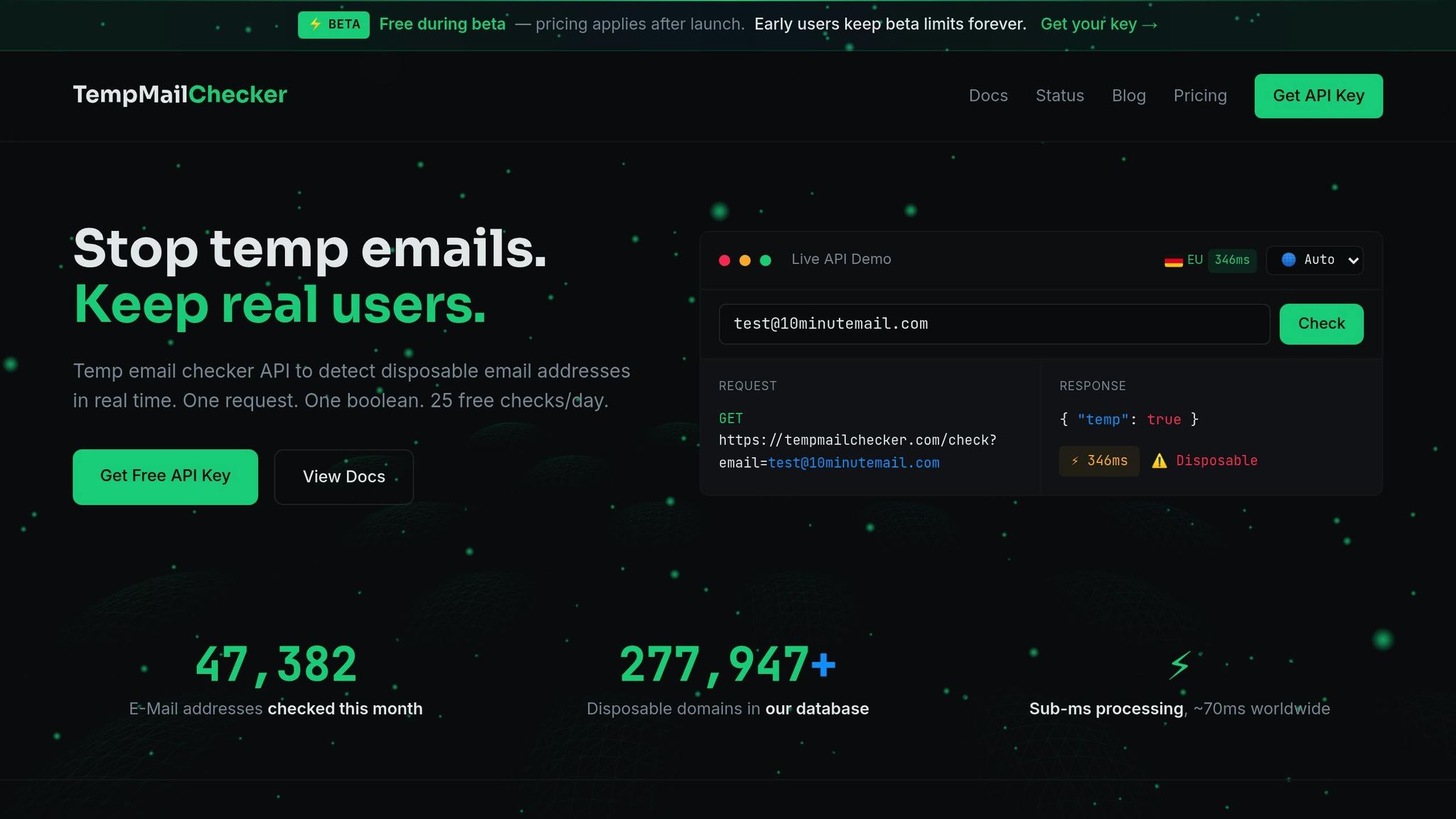
Start by selecting a plan that matches how many email requests you expect to handle each month. For testing or small projects, the Free plan gives you 25 requests per day - perfect for trying out the API. If you're ready to move into production, the Starter plan costs $12/month and provides 3,000 requests per month without daily limits. It’s a good fit for startups or smaller websites with moderate sign-up activity.
If you're running a growing SaaS platform or marketplace, the Growth plan at $29/month offers 15,000 requests and higher burst limits to handle increased traffic. For e-commerce sites or industries dealing with heavy traffic and higher risks, the Scale plan at $69/month supports 60,000 requests with guaranteed performance. Need more? Enterprises managing over 250,000 requests monthly can opt for custom pricing, which includes SLA guarantees and dedicated account support.
Once you've picked the plan that works for you, it's time to integrate the API into your workflow.
API Integration Steps
Integration is straightforward using the REST API with JSON. First, grab your API key from the dashboard. You’ll include this key in your HTTP headers using either Authorization: Bearer YOUR_API_KEY or x-api-key: YOUR_API_KEY.
To verify an email, send a GET or POST request to the TempMailChecker endpoint, including the email address you want to check. The API will return a JSON response that confirms whether the email is disposable, along with other validation details. With just a few lines of code in your preferred programming language (like Python, JavaScript, or PHP), you can seamlessly add disposable email detection to key areas such as sign-up forms, checkout pages, or other user input points.
Once integrated, you’re ready to take advantage of everything TempMailChecker has to offer.
Using TempMailChecker's Key Features
TempMailChecker works incredibly fast, verifying emails in sub-millisecond times to keep your sign-up flows running smoothly. It uses a constantly updated database of over 277,938 disposable domains, ensuring it catches even newly created temporary email services. To further enhance speed, regional endpoints route requests to servers closest to your users, minimizing latency.
The API performs layered validation checks, including syntax, domain verification, MX lookup, and SMTP validation. These checks help identify disposable emails, spam traps, catch-all servers, and role-based addresses. By deploying the API across all your data collection points - think registration forms, newsletter sign-ups, contact forms, or CRM imports - you can ensure your email lists stay clean and reliable from the start.
Conclusion
Safeguarding your business from disposable emails is much more effective with API-based detection than relying on manual verification. Manual methods simply can't keep up with the rapid rise of disposable email services. In fact, outdated disposable email lists can see their accuracy plummet from 64% in just one week to a mere 43% within a month.
Automated solutions stand out as the better option. API-based detection offers real-time verification, checking emails instantly as users input them. With TempMailChecker's constantly updated database, new temporary domains are identified quickly and efficiently. Instead of spending time manually updating lists, you benefit from automated protection that scales seamlessly - whether you're processing 25 requests daily or over 250,000 each month.
The efficiency difference is striking. Manual verification becomes unmanageable with higher sign-up volumes, but TempMailChecker handles it with ease. Its multi-layered validation process - covering syntax, domain checks, MX records, and disposable email detection - takes just milliseconds. The result? Cleaner email lists, fewer fake accounts, and improved user engagement, all without adding extra work for your team.
FAQs
What are the key benefits of using an API for detecting disposable email addresses compared to manual verification?
Using an API to detect disposable emails comes with several key benefits compared to manual checks. For starters, APIs provide real-time validation, delivering fast and precise results without any manual effort. This speed and automation make it easier to handle large batches of email addresses efficiently.
Another advantage is that APIs are regularly updated to identify new disposable email domains. This helps reduce false positives and ensures a higher level of accuracy. For businesses managing heavy traffic or needing a scalable solution, APIs offer a dependable way to prevent fake signups and misuse.
How does using an API for disposable email detection help businesses scale effectively?
API-based disposable email detection streamlines the verification process, making it possible for businesses to handle large volumes of email addresses in real time. This eliminates the need for manual checks, speeds up workflows, and ensures reliable accuracy across the board.
With an API in place, companies can quickly identify and filter out disposable emails, block fake signups, and safeguard their systems from potential misuse. This automated solution not only saves time and resources but also supports businesses in managing high user traffic while maintaining the integrity of their data.
When is manual email verification still a good option?
Manual email verification is particularly useful in scenarios where human judgment or a tailored approach is necessary. For instance, it can help review suspicious or high-risk email addresses, tackle edge cases where automated tools might fall short, or provide the context needed for a well-informed decision.
Although it's not as fast as using an API, manual checks offer an extra layer of confidence in situations where precision is paramount - like verifying sensitive accounts or managing unique, one-off cases.