How Disposable Emails Enable Free Trial Abuse
Disposable email abuse is costing businesses billions annually. Here's what you need to know:
- Free trial abuse happens when users exploit free trials by creating multiple accounts using disposable emails, avoiding payments entirely.
- Disposable emails are temporary, anonymous inboxes that bypass verification and are often used in automated attacks.
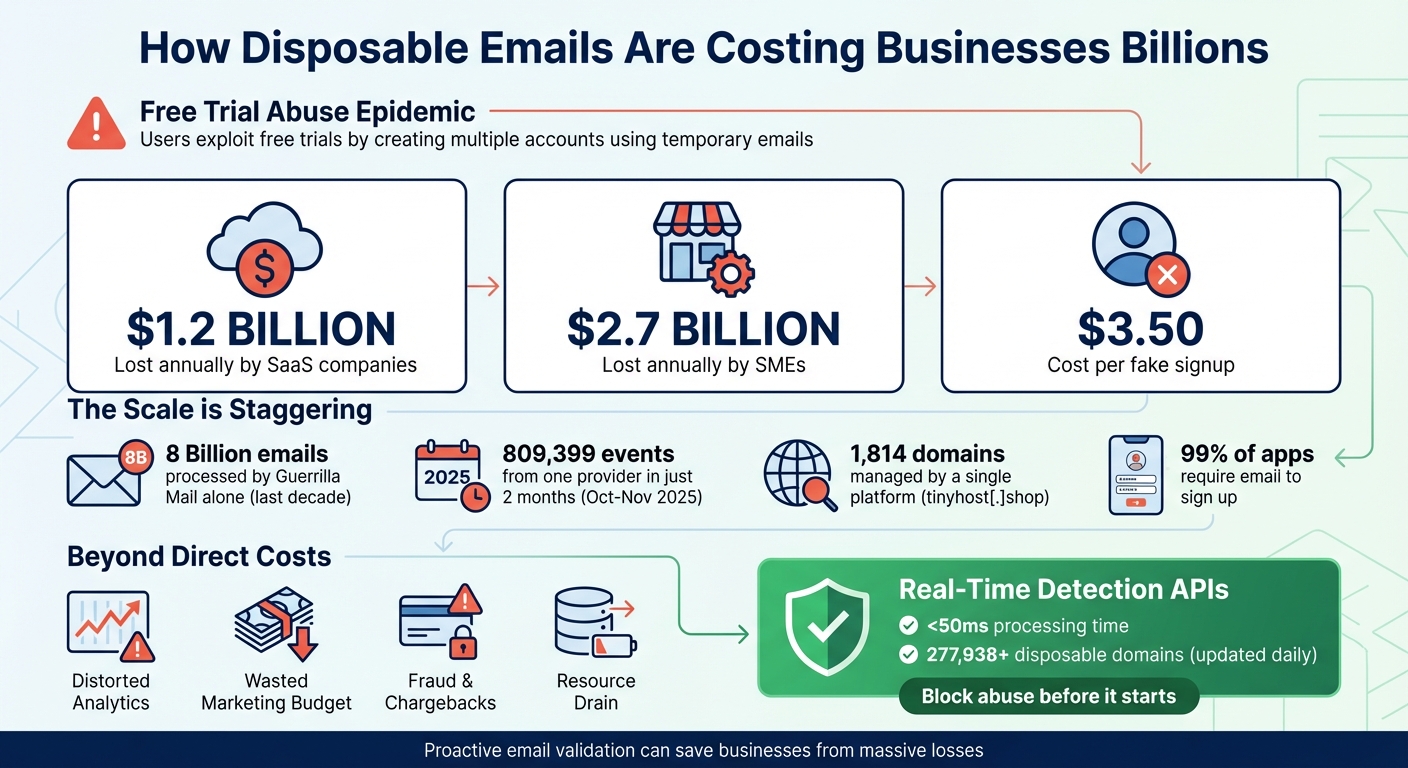
- The financial impact is severe: SaaS companies lose $1.2 billion annually, and SMEs face $2.7 billion in losses. Each fake signup costs about $3.50 in resources.
- Other damages include distorted analytics, wasted marketing budgets, and fraud risks like chargebacks.
Businesses can fight back by using real-time detection APIs like TempMailChecker to block disposable emails during signups. These tools help protect resources, maintain data integrity, and ensure genuine user engagement.
Key takeaway: Disposable email abuse is a growing problem, but proactive measures like email validation APIs can save businesses from massive losses.
Financial Impact of Disposable Email Abuse on Businesses
How Disposable Emails Work and Why They're Used for Abuse
How Disposable Emails Work
Disposable email services create temporary inboxes on the spot without requiring users to sign up. These platforms use a clever system to redirect MX records across numerous domains, all managed by a central infrastructure. Essentially, one service can operate thousands of domains at once.
"Think of it like a rental umbrella - perfect for a sudden rainstorm, but not something you'd rely on forever." - Logto
To evade detection by security filters, these services regularly rotate their domains, often choosing ordinary-looking .com or .net extensions rather than obvious throwaway ones. For instance, a platform named tinyhost[.]shop was found managing 1,814 different email domains, all used for automated abuse. Between October and November 2025, domains controlled by just one disposable email provider were responsible for 809,399 events, including account signups and logins.
Some providers even offer public APIs that allow programmatic inbox management. This automation transforms what could be a simple manual process into a large-scale operation. While this infrastructure supports legitimate privacy needs, it also opens the door to widespread abuse.
Why Users Choose Disposable Emails
Disposable emails are popular because they allow users to quickly and anonymously create email addresses. This appeals to privacy-conscious individuals who want to avoid spam, especially since almost 99% of modern apps require an email address to sign up.
But the same features that help protect privacy also make these services attractive to abusers. Since disposable emails aren’t linked to real identities, attackers can use automation to generate thousands of accounts in just minutes. This lack of accountability makes disposable emails a go-to tool for exploiting free trials and other online resources.
Common Abuse Patterns Using Disposable Emails
Attackers often rely on automated browsers to complete signup forms, monitor disposable inboxes for verification links, and finalize account creation - all without human involvement.
One particularly effective tactic is alias exploitation, which uses techniques like plus addressing and dot neutrality to route multiple email addresses to a single inbox. When combined with VPNs and device fingerprint rotation, attackers can mimic unique, legitimate users while concealing their true identity.
The most damaging abuse pattern is resource farming. Here, attackers focus on platforms offering valuable resources, draining backend credits on a massive scale. For example, Guerrilla Mail, one of the earliest disposable email services, has handled approximately 8 billion emails over the past decade. This staggering figure highlights just how widespread disposable email usage has become, particularly for large-scale abuse like free trial exploitation.
Why Traditional Defenses Fail Against Disposable Email Abuse
The Limitations of Basic Security Measures
Standard security measures like email verification links, CAPTCHAs, and IP blocking often fall short against disposable email abuse. Automated botnets can easily follow verification links to complete account setups without any human involvement.
CAPTCHAs, once considered a robust defense, are now largely ineffective. As Zack Proser from WorkOS explains:
"CAPTCHA won't help if you're dealing with human-solving farms or tools that replay user input".
Attackers bypass these barriers by either paying for human-solving services or using advanced tools that mimic legitimate user behavior.
IP rate limiting also struggles to keep up. Abusers rely on VPNs, residential proxies, and IP rotation to appear as unique users. Static blocklists, another common approach, quickly become obsolete as disposable email providers frequently change domains to evade detection. Even payment processor blocklists, like those used by Stripe Radar, often fail to update quickly enough to catch new disposable domains. These limitations leave the door open for increasingly sophisticated evasion tactics.
Evasion Techniques Used by Abusers
Bad actors employ a range of advanced techniques. Aliasing methods, as mentioned earlier, remain a common strategy. Additionally, virtual payment cards from neo-banks and privacy-focused services allow them to generate valid card numbers, which can be deactivated before a trial ends.
Automation tools like Puppeteer are another weapon in their arsenal. These tools can fill out signup forms, monitor temporary inboxes, and even click verification links without any manual effort. The scale of abuse can be staggering - one reported case involved an attacker exploiting disposable email addresses to rack up $220 in GPU credits in just an hour.
Security Gaps in Current Systems
Beyond individual tactics, broader systemic vulnerabilities make free trial defenses especially weak. Most traditional systems treat each signup attempt as an isolated event. They check if an email address looks valid or if an IP address seems legitimate but fail to spot patterns that signal abuse. Attackers exploit this blind spot by using "abuse kits" that simulate clean browser environments and rotate IP addresses, making their activity appear genuine.
Another growing challenge comes from mainstream privacy services like Apple's Hide My Email and Firefox Relay. These services act as persistent email relays, making them harder to flag than traditional disposable domains. Complicating matters, these tools are also widely used by legitimate, privacy-conscious users. This creates a tough choice: block these services and risk alienating real users, or allow them and leave your system vulnerable to abuse.
As Zack Proser succinctly puts it:
"You can't trust email validation when every attacker has access to inbox automation and fresh domains".
Static defenses simply cannot keep up with the increasingly industrialized and automated nature of modern free trial abuse.
Using APIs to Detect Disposable Emails in Real-Time
The Benefits of Real-Time Detection
Real-time detection APIs act as gatekeepers, stopping fake accounts before they infiltrate your system. When a user submits a form, the API quickly extracts the email domain and checks it against an extensive database of disposable email providers. The entire process takes less than 50 milliseconds, allowing your system to block fraudulent sign-ups on the spot while ensuring legitimate users experience no interruptions.
This immediate action does more than just protect your free trial budget - it also safeguards the quality of your data. Disposable emails often lead to high bounce rates, which can hurt your sender reputation and distort your analytics. By filtering out these temporary accounts, real-time detection ensures that your onboarding metrics, retention rates, and customer insights are based on genuine users. Without this proactive approach, fake accounts can drain resources and skew your growth metrics.
This seamless layer of protection sets the stage for advanced API features tailored for efficient integration.
Key Features of TempMailChecker
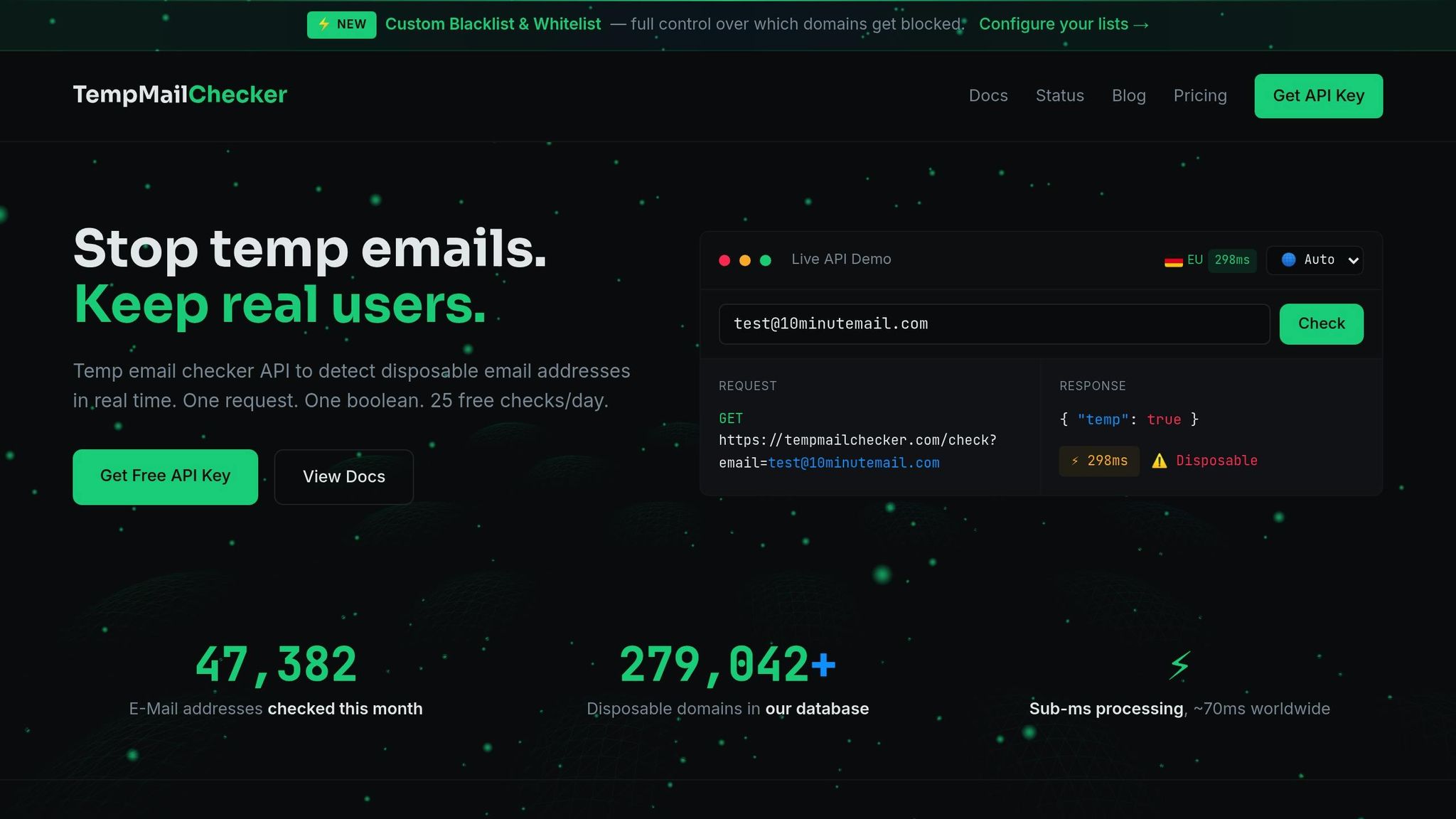
TempMailChecker is designed for fast, reliable email validation, making it an ideal choice for real-time detection. Its low-latency performance ensures sub-millisecond processing, allowing it to integrate smoothly into your signup flow without disrupting the user experience. The service maintains a constantly updated database of over 277,938 disposable domains, with daily updates to catch new providers as they appear.
The API provides a simple JSON response with a boolean field, "disposable", making it easy to implement across multiple programming languages. Beyond basic checks, it verifies MX records, performs SMTP validation, and flags privacy-focused relays like Apple’s Hide My Email and Firefox Relay, depending on your risk tolerance.
TempMailChecker also offers flexible pricing to suit different needs. It includes a free tier with 25 daily requests for testing and local development. Paid plans start at $12 per month for 3,000 requests, with options to scale up for enterprise-level usage, including dedicated support and service-level agreements (SLAs).
How to Integrate Disposable Email Detection
Integrating disposable email detection into your workflow is straightforward. First, secure your unique API key from the TempMailChecker dashboard and store it safely as an environment variable - never include API keys in version control. When a user submits their email during signup, intercept the address on your backend and send it to the TempMailChecker API, including your authentication token in the request header.
Before sending the email to the API, normalize it by removing Gmail dots and plus-sign aliases. If the API returns "disposable": true, block the registration and show a clear message like: "Please use a permanent email address for account recovery and support".
For added security, combine the API check with other measures such as device fingerprinting and VPN detection to counter more sophisticated abusers. As Thomas Petracco, Founder of UserCheck, explains:
"The goal isn't to get [abuse] to zero, it's to make it difficult enough for abusers to not bother".
To handle temporary network issues, use exponential backoff for retries - waiting 5 seconds, then 10, then 20 - rather than overwhelming the API with repeated requests. Additionally, keep an eye on your detection rates. A sudden spike could indicate a coordinated abuse campaign targeting your platform.
sbb-itb-cfbd9fd
Conclusion
Key Takeaways
Disposable emails have become a serious challenge, draining resources and skewing business insights. Real-world examples show how attackers exploit temporary inboxes to misuse valuable resources like GPU credits, API calls, and compute power, leading to immediate financial losses.
The damage doesn’t stop there. Fake signups distort your analytics - messing up conversion rates, retention metrics, and A/B testing results. This leads to poor strategic decisions. Meanwhile, marketing budgets spiral as they target users who will never convert, and your infrastructure struggles to handle botnets generating fraudulent accounts at scale. These combined effects create a major barrier to your platform’s growth.
Traditional defenses like CAPTCHAs and IP blocking often fall short. Attackers easily bypass these measures using residential proxies and automated CAPTCHA solvers. A more effective solution is real-time API detection, which validates emails during signup and blocks disposable domains before they can harm your platform. This approach protects your trial budgets, data integrity, sender reputation, and operational efficiency.
Next Steps for Implementation
The need to act against disposable email abuse is clear and pressing.
Start by incorporating TempMailChecker into your signup process. This tool identifies disposable emails instantly, thanks to its sub-millisecond processing and a database of over 277,938 domains updated daily. It stops abusers while maintaining a seamless user experience. The free tier supports 25 requests per day for testing, while paid plans start at just $12 per month for 3,000 requests - a small investment compared to the potential losses from unchecked abuse.
Additionally, normalize email addresses to block aliasing tricks. For example, strip plus-addressing (like user+1@gmail.com) and remove dots from Gmail addresses to prevent users from creating multiple accounts with the same inbox. Combine email detection with tools like device fingerprinting and VPN checks to catch more sophisticated abusers. By making abuse costly and time-consuming, you can protect your platform in the long run.
How Does Email Validation Detect Temporary Email Addresses? - TheEmailToolbox.com
FAQs
How can businesses detect and prevent disposable email abuse effectively?
Businesses can tackle the misuse of disposable email addresses by verifying email addresses in real time during the registration process. Tools like TempMailChecker offer a powerful solution, enabling companies to quickly detect and block emails originating from known temporary domains. These APIs are backed by a continually updated database of over 277,000 disposable domains and deliver lightning-fast response times - often within sub-milliseconds. This makes them a seamless addition to user registration or checkout workflows.
For added security, businesses can adopt other measures, such as tracking repeated registrations from the same IP address or device and requiring credit card verification for free trial access. By combining real-time email validation with these strategies, companies can create a secure and smooth experience for legitimate users while effectively deterring abuse from disposable email accounts.
How do disposable emails lead to financial losses from free trial abuse?
Businesses often face challenges from disposable emails, particularly when they're used to exploit free trials. This practice directly impacts revenue as users continuously take advantage of trial services without transitioning to paid plans. On top of that, it drives up operational expenses, including increased infrastructure demands and wasted resources like GPU credits.
But the damage doesn't stop there. Free trial abuse can skew critical business metrics such as user growth, churn rates, and engagement levels. These distorted figures can lead to poor strategic decisions and flawed financial planning. Implementing real-time detection tools offers a practical way to tackle these issues and reduce the associated risks.
Why can’t traditional security measures stop disposable email abuse?
Traditional security tools, such as basic email checks or verification links, often fall short when dealing with disposable emails. These temporary addresses are specifically designed to bypass such measures. Disposable email services can generate valid-looking addresses almost instantly, usually without requiring any registration, and they expire quickly. This makes it easy for users to create multiple accounts and exploit free trials, sidestepping the typical one-account-per-email rule.
Because disposable emails are anonymous and lack features like recovery options or two-factor authentication, they’re a favorite tool for fraudsters and bots. They can rotate these addresses frequently, making them difficult to track. Static blacklists or pattern-matching methods simply can’t keep pace with the endless creation of new throwaway domains. To effectively combat this issue, real-time detection is key. Tools like TempMailChecker provide instant identification of disposable domains, enabling businesses to block fake sign-ups and safeguard their resources with lightning-fast precision.