Prevent Multi-Account Fraud with Disposable Email Detection
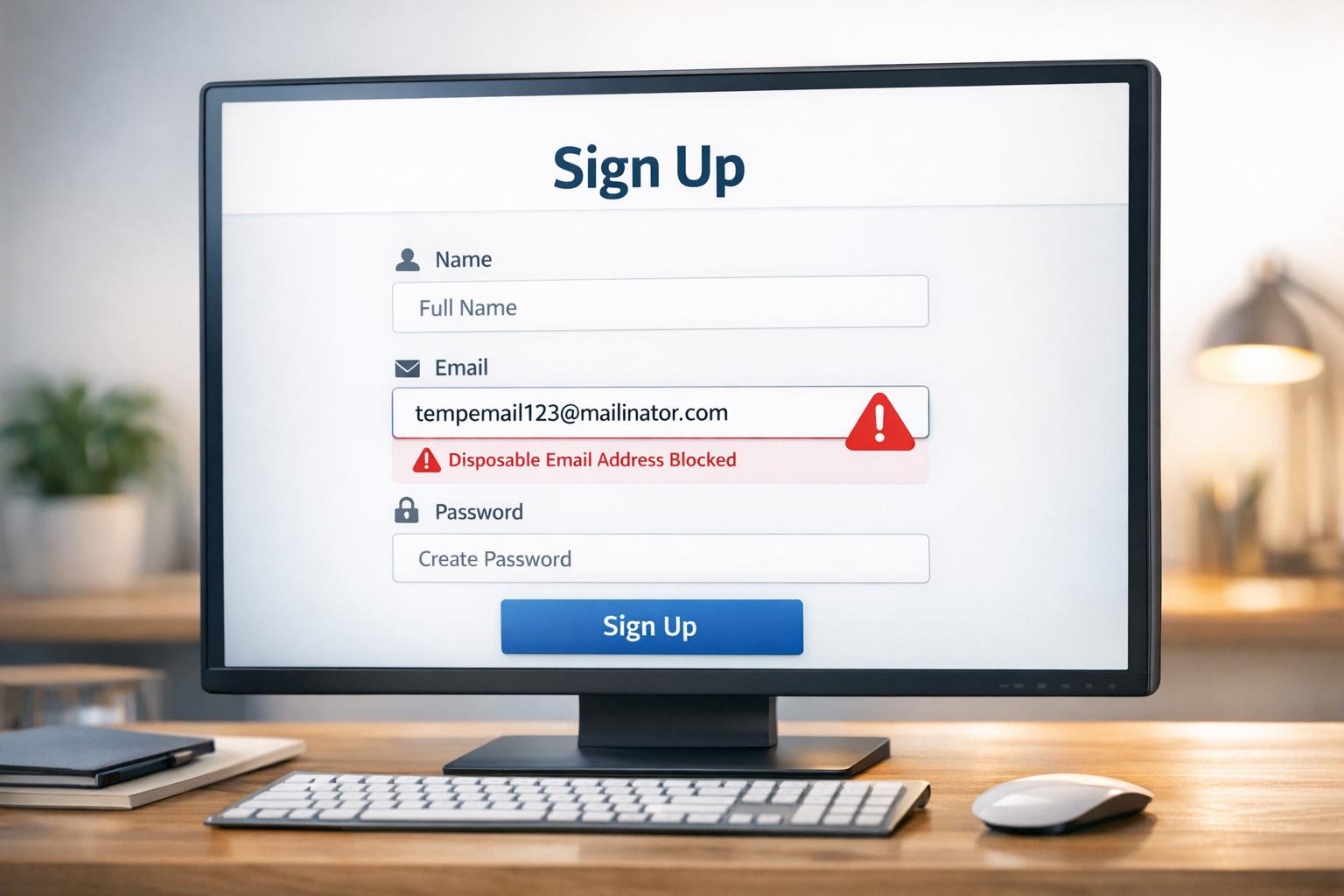
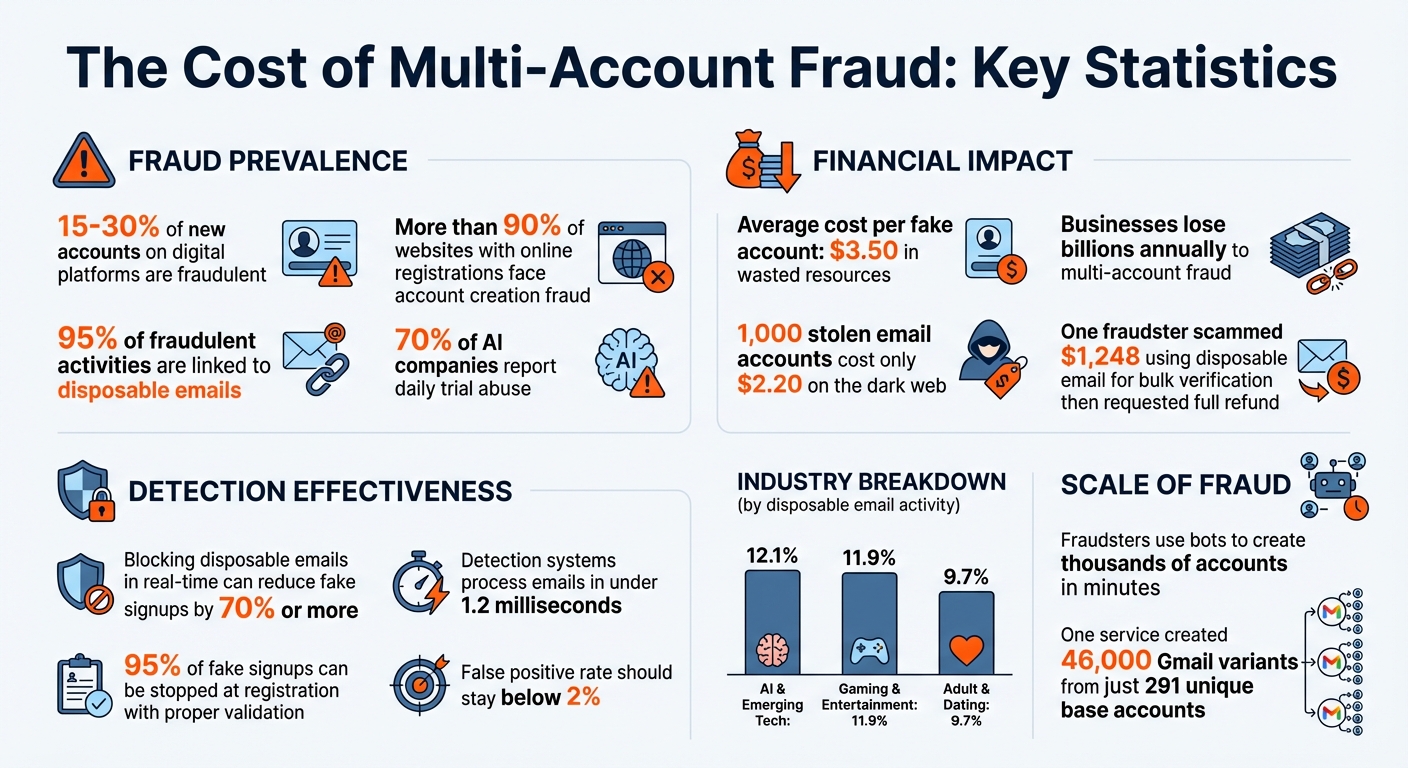
Preventing multi-account fraud starts with identifying disposable email addresses. These temporary inboxes are a favorite tool for fraudsters, enabling them to create fake accounts, abuse free trials, claim referral rewards, and distort platform data. Businesses lose billions annually to such activities, with fake accounts costing an average of $3.50 each in wasted resources.
Key Takeaways:
- 15% to 30% of new accounts on digital platforms are fraudulent.
- Disposable emails are linked to 95% of fraudulent activities.
- Fraudsters use bots to create thousands of accounts in minutes, leveraging disposable emails to bypass verification.
- Blocking these emails in real time can reduce fake signups by 70% or more.
Tools like TempMailChecker help businesses detect and block disposable emails instantly. By integrating its API, you can protect your platform, save server resources, and maintain clean data. Plans start at $12/month, making it an affordable solution for businesses of all sizes.
Multi-Account Fraud Statistics and Impact on Digital Platforms
Prevent Scams: How to Stop Fraudsters Place Orders Using Multiple Email Addresses
What Are Disposable Emails and How Do Fraudsters Use Them?
Disposable emails are temporary, anonymous inboxes designed for short-term use. They let users receive messages without connecting the address to a permanent identity. Tyler Woodward, Technical Account Manager at Trestle, explains it well:
"Simply put, an email is considered disposable when it is temporary and discarded after the initial interaction, providing no expected value to the business."
The appeal lies in their simplicity - most services don’t require any signup or verification. Users can instantly generate an address, receive emails, and the inbox automatically clears itself after a short period, often within hours or days, leaving no trace.
Main Features of Disposable Emails
These emails are designed for instant use with minimal effort. No passwords, phone numbers, or identity verification are required. Some services even offer public inboxes, meaning anyone with access to the email address can view incoming messages.
There are two primary types:
- Ephemeral inboxes: These are single-use addresses that expire within a short time.
- Email aliases: These are persistent relays, like Apple's "Hide My Email", which forward messages to a primary inbox.
Fraudsters also manipulate Gmail’s features through tricks like "dot normalization" (ignoring dots in email addresses) and "plus aliasing" (ignoring everything after a "+" symbol). For instance, the service Emailnator managed to create 46,000 Gmail variants from just 291 unique base accounts.
Here’s a quick comparison of disposable emails versus regular email services like Gmail or Outlook:
| Feature | Disposable Email Address | Regular Email (Gmail/Outlook) |
|---|---|---|
| Lifespan | Temporary; lasts minutes to days | Permanent; designed for long-term use |
| Identity | Anonymous; no personal info required | Linked to a verified identity |
| Setup | Instant; no registration needed | Requires signup and often two-factor authentication |
| Security | Low; many inboxes are public | High; protected with passwords and encryption |
These characteristics make disposable emails particularly appealing for fraudsters, as outlined below.
How Fraudsters Use Disposable Emails to Create Multiple Accounts
Fraudsters take advantage of disposable emails to create accounts at scale. Using bots, they can generate thousands of accounts in minutes. The bots fill out signup forms, monitor disposable inboxes for verification links, and automatically complete the account creation process.
Industries like AI, gaming, entertainment, and online marketplaces are common targets. These sectors often deal with fraudulent login attempts, fake account registrations, and abuse of free trial offers.
One striking example occurred in early 2025, when a bulk-email verification service fell victim to a calculated scam. A fraudster used a disposable email to purchase $1,248.00 worth of services. Over two days, they verified a large database and then requested - and successfully received - a full refund. The company suffered losses not only from the service usage but also from the administrative costs of processing the refund.
Fraudsters also use disposable emails for account hijacking. After compromising a legitimate account, they change the recovery email to a disposable address (e.g., jugarmail.com or tenermail.com), locking out the original owner and maintaining control. On the dark web, hackers can buy 1,000 stolen email accounts for as little as $2.20, making mass account creation both cheap and scalable.
Recognizing these tactics is essential for implementing effective real-time detection and prevention measures.
How Real-Time Disposable Email Detection Stops Fraud
Real-time disposable email detection acts as a security checkpoint during the signup process. Instead of allowing fraudulent accounts to slip through and dealing with the fallout later, these detection systems stop fraud in its tracks. When someone enters an email address, the system evaluates it instantly - often in under 1.2 milliseconds - and determines whether to approve or reject the signup. This swift action drastically reduces both financial losses and operational headaches.
By blocking fake signups at the source, businesses avoid significant costs. This includes saving on server resources, cutting down on unnecessary email service fees, and reducing the burden on customer support teams who would otherwise handle illegitimate accounts.
The Technical Process Behind Disposable Email Detection
Disposable email detection operates through several layers of analysis. The first step is domain database comparison, where the system checks the email's domain against a massive, continuously updated database of over 5,000 known disposable email providers like Mailinator or 10minutemail. The second layer involves verifying MX records through DNS lookups to confirm valid Mail Exchange records and ensure proper mail server configurations.
More advanced systems incorporate AI to detect risk indicators, such as the age of the email account, suspicious signup patterns (like multiple accounts created from the same IP address), and unusual character sequences in the email address. These tools can also identify alias abuse, where fraudsters exploit features like Gmail's "plus addressing" to generate multiple accounts from a single inbox.
Some systems go even further by verifying the email's social footprint. They check whether the address is linked to profiles on platforms like Google or LinkedIn, review its history in data breaches, and confirm its validity with major providers like Gmail or Outlook.
Businesses typically integrate these detection systems into their signup forms using REST APIs. When a user submits their email, the API delivers a verdict - either "BLOCK" or "PASS" - to prevent fraudulent registrations before the account creation process is completed. This layered approach not only enhances security but also strengthens the overall reliability of the platform.
Why Businesses Need Disposable Email Detection
Beyond just blocking fraud, real-time detection improves business operations by maintaining clean, reliable data and safeguarding email sender reputations. By ensuring bot-driven accounts never interfere, it keeps analytics and A/B testing results accurate. It also prevents CRM systems from becoming cluttered with fake accounts, eliminating the need for costly cleanups.
Protecting sender reputation is another critical benefit. Emails sent to expired disposable addresses often bounce, and too many bounces can harm your reputation as a sender. This can lead to legitimate emails - like password resets - being flagged as spam or not delivered at all.
The savings are substantial. By cutting down on fake subscribers, reducing server strain, and avoiding inflated support ticket volumes, businesses can significantly lower their exposure to fraud. As Thomas Petracco, Founder of UserCheck, explains:
"The goal isn't to get it [abuse] to zero, it's to make it difficult enough for abusers to not bother."
Certain industries are particularly vulnerable to disposable email fraud. AI & Emerging Tech sees 12.1% of disposable email activity, often tied to free-credit exploitation. Gaming & Entertainment follows at 11.9%, driven by promo code abuse. Adult & Dating sites experience 9.7%, frequently due to privacy concerns and spam-related activities. For these sectors, real-time detection is absolutely essential.
sbb-itb-cfbd9fd
How to Use TempMailChecker to Prevent Multi-Account Fraud
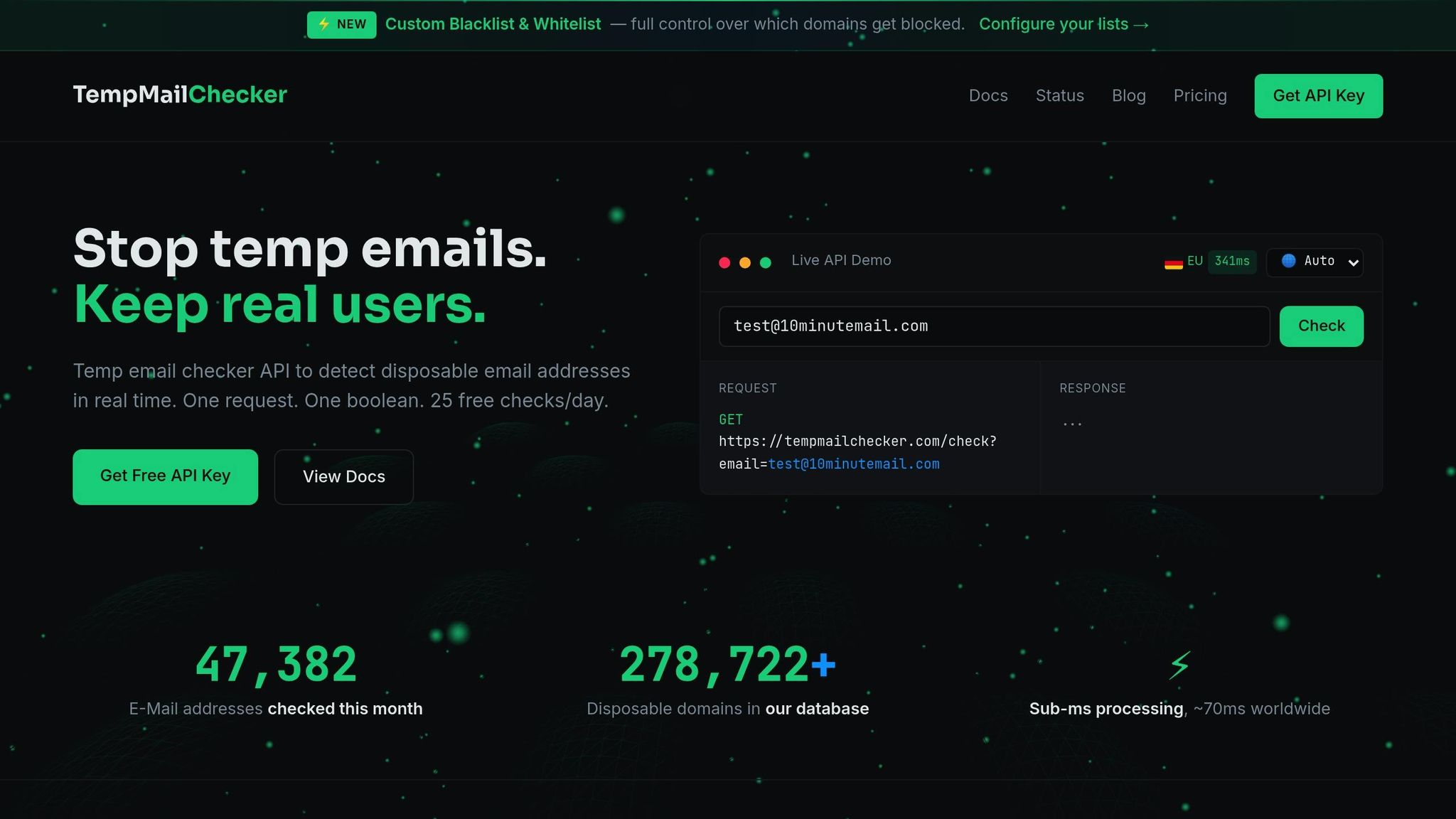
TempMailChecker provides a simple yet powerful way to block disposable emails and stop multi-account fraud before it begins. By integrating its REST API directly into your signup forms, you can instantly determine whether an email address is legitimate or temporary.
TempMailChecker Features and Capabilities
TempMailChecker boasts a massive database of 277,938+ disposable email domains, updated daily to stay ahead of new temporary email providers. Its JSON API is designed for compatibility with any modern web architecture, making it easy to integrate regardless of your tech stack.
To ensure fast response times, TempMailChecker uses a regional endpoint system. Requests are routed to servers in the US, Europe, or Asia, depending on your location, guaranteeing sub-millisecond processing times - even during peak traffic. The service also includes official SDKs with no external dependencies and built-in usage monitoring. This feature lets you track your daily request limits, current usage, and reset times directly through the API, so you’re always aware of your plan’s status.
With these features, integrating TempMailChecker into your system is a smooth process.
How to Integrate TempMailChecker into Your System
Getting started with TempMailChecker is quick and straightforward. Here’s how:
- Sign up and get your API key: Create an account on tempmailchecker.com and retrieve your API key from the dashboard. The free tier offers 25 requests per day, ideal for testing before going live.
-
Install the SDK: Choose the SDK for your programming language. For example, Go developers can use the command
go get github.com/Fushey/go-disposable-email-checker. Once installed, initialize the client with your API key and select the regional endpoint nearest your servers -EndpointUSfor the Americas,EndpointEUfor Europe, orEndpointAsiafor the Asia-Pacific region. -
Add verification to your signup form: When a user submits their email, call the
Checkmethod before creating their account. The API will return atempboolean - iftrue, the email is disposable, and you can reject the signup. For enhanced privacy or faster performance, you can use theCheckDomainmethod to validate only the domain portion of the email.
To handle rate limits, catch RateLimitError responses and implement retry logic to avoid disruptions.
TempMailChecker Pricing Plans
TempMailChecker offers flexible pricing plans to meet the needs of businesses of all sizes:
| Plan | Monthly Cost | Requests Included | Key Features |
|---|---|---|---|
| Free | $0 | 25/day | Full API access, all regional endpoints, ideal for testing |
| Starter | $12 | 3,000 | No daily rate limit, priority API routing, email support |
| Growth | $29 | 15,000 | Higher burst limits, priority support, great for SaaS platforms |
| Scale | $69 | 60,000 | Dedicated throughput, Slack support, best for e-commerce |
| Enterprise | Custom | 250,000+ | SLA guarantee, dedicated account manager, compliance support |
The Growth plan ($29/month) is a favorite among SaaS businesses and marketplaces, offering 15,000 monthly requests and the ability to handle traffic spikes with ease. High-risk industries like gaming, dating, and AI platforms often opt for the Scale plan, which provides 60,000 requests per month and additional support options.
How to Measure and Improve Your Fraud Prevention Results
Measuring the success of your fraud prevention efforts comes down to tracking the right data. Start with the volume of blocked signups. If TempMailChecker is keeping hundreds or thousands of disposable domains off your platform each month, you're cutting off a major source of abuse before it even starts.
Next, focus on your trial-to-paid conversion rate and resource consumption. When fake accounts are excluded from your analytics, conversion rates naturally improve, and free-tier compute costs drop. This is especially important considering that 70% of AI companies report daily trial abuse. Keep an eye on your false positive rate as well - this should stay below 2% to avoid locking out legitimate users. Another red flag is a spike in support tickets related to blocked signups; this could mean your detection system is being overly aggressive. Striking the right balance is key: you want to block fraud while keeping things smooth for real users.
Integrating TempMailChecker into your system should lead to noticeable results. You’ll see higher onboarding completion rates, fewer false positives, and reduced operational costs. These improvements are a direct reflection of how well real-time disposable email detection is working. Now, let’s dive into the key metrics you should be monitoring for effective fraud prevention.
Metrics to Track for Fraud Prevention Success
One of the most telling metrics is your onboarding completion rate. Genuine users usually complete all the setup steps, while fake accounts tend to drop off right after verification. If more users are finishing the onboarding process after you implement fraud detection, it’s a good sign your user quality is improving. Another useful metric is session duration. Accounts with extremely short sessions or rigid, predictable navigation patterns often signal bot activity.
Signup velocity is another critical metric. This measures how quickly accounts are being created from specific IP ranges, devices, or geographic areas. For example, if you see 50 new accounts registered from the same data center IP within 10 minutes, that’s likely a bot campaign, not organic growth. With robust validation tools, it’s possible to achieve a 70% or greater reduction in fake signups within the first month.
| Metric Category | Specific KPI to Track | Success Indicator |
|---|---|---|
| Prevention Volume | Blocked Disposable Domains | High number of blocked "temp-mail" domains |
| User Quality | Onboarding Completion Rate | Increase in % of users completing setup |
| Financial Impact | Chargeback/Refund Rate | Fewer fraudulent refund requests |
| System Health | False Positive Rate | Keeping rate below 2% |
| Growth Accuracy | Trial-to-Paid Conversion | Higher conversion rate from total signups |
| Operational Cost | Support Ticket Volume | Fewer tickets tied to fake profiles or spam |
While email detection is a powerful tool, combining it with additional methods can strengthen your defenses even further.
Additional Fraud Prevention Methods to Use with Email Detection
To build a more secure system, layer email detection with other strategies. For instance, device fingerprinting assigns a unique ID to each device based on its browser, operating system, and WebGL data. This identifier sticks around even if cookies are cleared. If multiple signups use different disposable emails but share the same device fingerprint, it’s likely one person behind them all.
You can also use velocity monitoring and IP intelligence to catch bulk signups from suspicious sources, like data center proxies, VPNs, or Tor nodes. Behavioral analysis is another effective tool - it looks at things like mouse movements, typing speed, and navigation behavior to separate bots from humans.
"The goal isn't to get it to zero, it's to make it difficult enough for abusers to not bother." - Thomas Petracco, Founder, UserCheck
Instead of outright blocking all suspicious users, consider incremental security measures. For example, trigger CAPTCHAs or multi-factor authentication only for users who score borderline on your risk scale. This keeps your signup process user-friendly while still catching fraudsters. Another tip is to normalize email inputs - strip dots and "+" aliases from Gmail addresses before checking for duplicates. This helps uncover "Gmail alias abuse", where one person creates multiple accounts using variations of the same inbox.
For most small to medium-sized businesses, a strong multi-layered validation system typically costs between $50 and $200 per month. It’s a small price to pay for peace of mind and a safer platform.
Conclusion
Multi-account fraud poses a serious challenge for businesses - more than 90% of websites that allow online registrations face issues with account creation fraud. Detecting disposable emails is a powerful way to stop fraudsters from taking advantage of your platform. By blocking temporary email addresses during registration, you can safeguard free trials, referral programs, and computing resources while maintaining accurate and clean user data.
TempMailChecker offers a reliable solution with its constantly updated database of over 277,000 disposable domains, lightning-fast processing times, and regional endpoints that integrate smoothly into your signup process. Their free tier provides 25 daily requests for testing, while paid plans for production use start at just $12 per month.
Email verification is an essential first step in fraud prevention. When combined with tools like device fingerprinting, IP intelligence, and behavioral analysis, you can create a strong defense strategy. With the right validation measures in place, 95% of fake signups can be stopped at registration.
Ignoring this issue can be costly. Fake signups drain billions of dollars from businesses each year, consuming resources with every fraudulent account. Real-time disposable email detection tackles this problem head-on, protecting your platform and cutting unnecessary expenses.
Begin with email verification - it’s an affordable and effective way to shield your business from multi-account fraud.
FAQs
How do disposable email addresses enable multi-account fraud?
Disposable email addresses give fraudsters an easy way to sidestep verification steps and churn out multiple accounts without much hassle. These temporary emails are often used to take advantage of free trials, free-tier services, and promotional offers, which can lead to distorted user metrics and shady activities.
By allowing the creation of throwaway accounts, disposable emails open the door for bad actors to misuse platforms, manipulate data, and erode trust in your business. Spotting and blocking these emails is a vital measure to curb multi-account fraud and safeguard your platform from abuse.
How does TempMailChecker help prevent fraud and protect my platform?
TempMailChecker provides a cutting-edge tool designed to spot disposable and temporary email addresses in real time. By quickly identifying throwaway email domains, it helps businesses prevent fake sign-ups, cut down on spam, and protect their platforms from potential fraud.
With access to an extensive database of more than 277,938 disposable domains and lightning-fast processing speeds measured in sub-milliseconds, TempMailChecker offers smooth integration. This ensures your platform stays secure while fostering trust among your users.
How does disposable email detection work in real time?
Real-time detection of disposable emails operates by instantly cross-referencing an email address with an ever-updating database of temporary email domains. When someone enters an email during signup, the system leverages the TempMailChecker API to verify the domain. In just under a millisecond, the API determines if the email originates from a disposable provider and responds with a clear result - either accepting or rejecting the address.
To maintain accuracy, the service constantly monitors public disposable email providers, adds newly identified domains, and evaluates factors like mail server setups and domain reputations. This process helps businesses block fake accounts and reduce fraud, all while keeping the signup process smooth and user-friendly.