7 Ways Temporary Emails Hurt Your SaaS Business
Temporary emails might seem harmless, but they can silently damage your SaaS business. They inflate costs, skew analytics, enable fraud, and drain resources. Here's what you need to know:
- Fake signups increase customer acquisition costs and waste marketing budgets.
- Free trial abuse lets users repeatedly access paid features without paying.
- Distorted analytics lead to poor product decisions and unreliable data.
- Email deliverability issues harm your sender reputation and compliance efforts.
- Fraud risks expose your platform to security threats and financial losses.
- Higher support costs result from fake accounts creating unnecessary workload.
- Lost revenue occurs when pricing models are undermined by abuse.
Blocking temporary emails at signup is key to protecting your business. Tools like TempMailChecker help stop these issues, saving time, money, and resources.
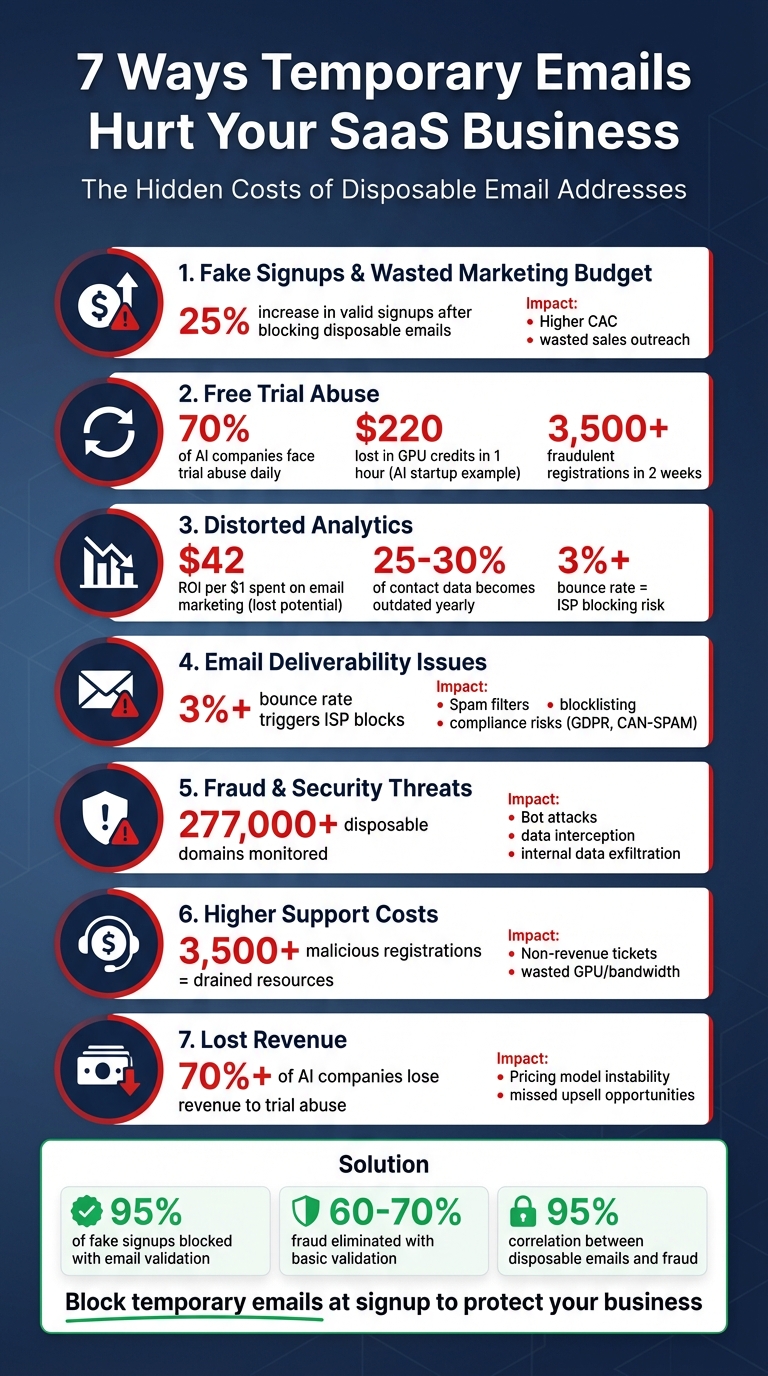
7 Ways Temporary Emails Hurt SaaS Businesses: Key Statistics and Impact
Did you know about this Temp Email Address Trick?
1. Fake Signups Increase Customer Acquisition Costs
Marketing dollars should focus on reaching real users who engage with your product and eventually pay for it. But when your signup funnel is flooded with temporary or disposable email addresses, you're essentially throwing money at users who are unlikely to convert. This drives up your customer acquisition cost (CAC) and wastes your budget.
When disposable emails dominate your signups, your CAC gives you a skewed picture of the actual cost of acquiring authentic users. Experts highlight that poor data quality and subscription fraud - often linked to email-based registrations - are challenges businesses work hard to avoid.
The problem doesn’t stop at acquisition costs. Follow-up efforts take a hit too. Sales teams waste valuable time reaching out to invalid email addresses. One startup saw a 25% boost in valid signups and better trial-to-customer conversion rates after they started blocking disposable email domains.
2. Free Trial and Freemium Abuse
Free trials and freemium plans are designed to let users test a product before committing, but disposable emails have turned this into a loophole for abuse. By using these temporary accounts, individuals can repeatedly access paid features without ever converting to paying customers. The result? A financial drain that companies are struggling to control.
Over 70% of AI companies report dealing with trial abuse on a daily basis. One alarming example comes from 2025, when an AI startup lost $220 in GPU credits in just one hour due to repeated signups using disposable emails. Another Castle customer documented over 3,500 fraudulent registrations from bots and throwaway emails in just two weeks.
"Free trial abuse is a form of subscription fraud, often orchestrated by botnets that generate thousands of accounts solely to drain free resources." - Amrit Khera
The problem has become so severe that some companies have given up on free trials altogether. For instance, Midjourney CEO David Holz decided to discontinue trials after facing overwhelming demand and widespread abuse. To counter this, many major platforms have started blocking temporary email services during signups.
But disposable emails are just the tip of the iceberg. Abusers have become more sophisticated, using tricks like email aliases (e.g., Gmail's plus addressing), email forwarding services (such as Apple's Hide My Email and SimpleLogin), and automated tools that can generate thousands of unique addresses - all funneling back to the same inbox. Without robust detection systems, identifying and stopping these repeat offenders becomes an uphill battle.
3. Distorted Analytics Lead to Poor Product Decisions
Temporary emails don’t just inflate acquisition costs and enable trial abuses - they also wreak havoc on your analytics, making it harder to craft a solid product strategy. When disposable addresses flood your signup forms, they undermine the quality of your data. Sure, your signup numbers may look great, but key engagement metrics like open rates, click-through rates, and feature usage plummet. It creates the illusion of growth while leaving you with a pile of email addresses that never convert into active users.
Here’s the thing: email marketing is supposed to deliver big returns, with an average of $42 for every $1 spent. But that potential vanishes when your data is compromised. Disposable emails lead to higher bounce rates and lower open rates. And if your email list hits a hard bounce rate of 3% or more, Internet Service Providers might block you altogether, putting your entire email strategy at risk. This poor data quality also throws off controlled experiments like A/B tests, making it harder to draw accurate conclusions.
For product teams, the problem doesn’t stop there. Testing and feature analysis become a nightmare. Let’s say you’re running an A/B test for a new feature or pricing model. Temporary email users - who often sign up just to snag free trials - skew your results. These users distort feature usage data, leading to misleading insights like low adoption rates, poor conversion numbers, and shorter customer lifecycles. The noise created by these accounts makes it nearly impossible to separate real trends from irrelevant data.
And the damage compounds over time. Experts estimate that 25% to 30% of an organization’s contact data becomes outdated every year. Add temporary emails into the mix, and this data decay speeds up dramatically. The result? Misguided decisions about everything from product roadmaps to marketing budgets and resource allocation.
If you don’t filter out temporary emails, your metrics become unreliable. Your dashboard might show thousands of new signups, but your revenue stays stagnant. Engagement data might suggest that users don’t care about new features, even though genuine users never received your emails in the first place. Without trustworthy numbers, every strategic move becomes a shot in the dark.
4. Damaged Email Deliverability and Compliance Issues
Temporary email addresses don’t just mess with your data - they also make it harder to connect with real customers. When these throwaway addresses flood your email list, they create serious deliverability problems. Since disposable emails are often abandoned quickly, sending messages to them results in hard bounces, which can seriously harm your sender reputation.
Think of your sender reputation like a credit score - Internet Service Providers (ISPs) like Gmail and Outlook keep a close eye on your bounce rates to determine how trustworthy you are. If your bounce rate climbs to 3% or more, ISPs may start blocking your emails entirely. Even before hitting that threshold, higher bounce rates can trigger spam filters, sending your carefully crafted campaigns straight to the junk folder. On top of that, some disposable emails act as spam traps - essentially bait designed to catch senders with poor list hygiene. Falling into these traps can lead to blocklisting, which can cripple your email operations.
But deliverability isn’t the only issue. Temporary emails also come with compliance risks. They make it harder to verify user identity and location, which can put your business at odds with regulations like GDPR and CAN-SPAM. For example, if you unknowingly accept signups from regions under U.S. sanctions, you could face penalties - especially if fraudulent identities are involved.
Recovering from a damaged sender reputation isn’t quick or easy. It can take weeks or even months, during which time critical emails like password resets and product updates might not reach your users. The solution? Block disposable emails at the signup stage. By using tools that automatically update their database of temporary email domains, you can safeguard both your deliverability and compliance - without the headache of constant manual monitoring.
sbb-itb-cfbd9fd
5. Fraud and Account Security Threats
Temporary emails have become a go-to tool for fraudsters. Using bots, attackers can churn out thousands of fake accounts in mere minutes. These accounts are often used to exploit free trials, flood platforms with spam, or drive up infrastructure costs. This is especially problematic for AI-powered SaaS platforms, where every abusive account adds extra GPU or compute expenses.
Many disposable email services come with another major flaw: they’re either public or easily guessable, making them vulnerable to interception. As Atomic Mail explains:
"There is a very high probability. If the service doesn't require a password, anyone who can guess your randomly assigned disposable email address could potentially view your inbox. The service provider itself almost certainly can".
This means sensitive communications, like password resets, one-time passwords, or receipts, can fall into the wrong hands.
On top of interception risks, disposable email services often lack basic security measures like encryption, detailed logging, or secure server protocols. This creates compliance challenges and makes it difficult to establish a clear ownership trail. For accounts tied to identity, finances, or long-term access, these gaps can lead to serious complications.
The risks don’t stop with external attackers. Even internal actors can misuse temporary emails to exfiltrate sensitive data, slipping confidential files out of the organization undetected by traditional IT security systems. This internal misuse only adds to the already significant external threats, further jeopardizing platform security.
To address these vulnerabilities, blocking temporary email domains during the signup process is critical. Using updated databases that monitor over 277,000 disposable domains can help neutralize these threats before they pose a risk to your platform.
6. Higher Support and Operations Costs
Temporary emails don’t just pose fraud risks - they also pile on extra work for your support and operations teams. Every fake account created with a temporary email adds to the support burden. Why? Because when users fail to receive critical emails like password resets, onboarding instructions, or billing notifications, they often reach out to support for help. This leaves teams scrambling to resolve issues like missed onboarding steps, billing confusion, or incomplete account notifications - all of which could have been avoided. Worse yet, abusers using disposable emails for free trials often generate support tickets without ever converting, further clogging up the system with non-revenue-generating tasks.
For SaaS companies that charge based on usage, the problem gets even more expensive. Take, for example, an AI-based image generator using Castle's services. Over just two weeks, they faced more than 3,500 malicious registration attempts, mostly from bots and users relying on disposable emails. Each of these fake accounts drained server resources, GPU time, and bandwidth - resources that should have been reserved for paying customers.
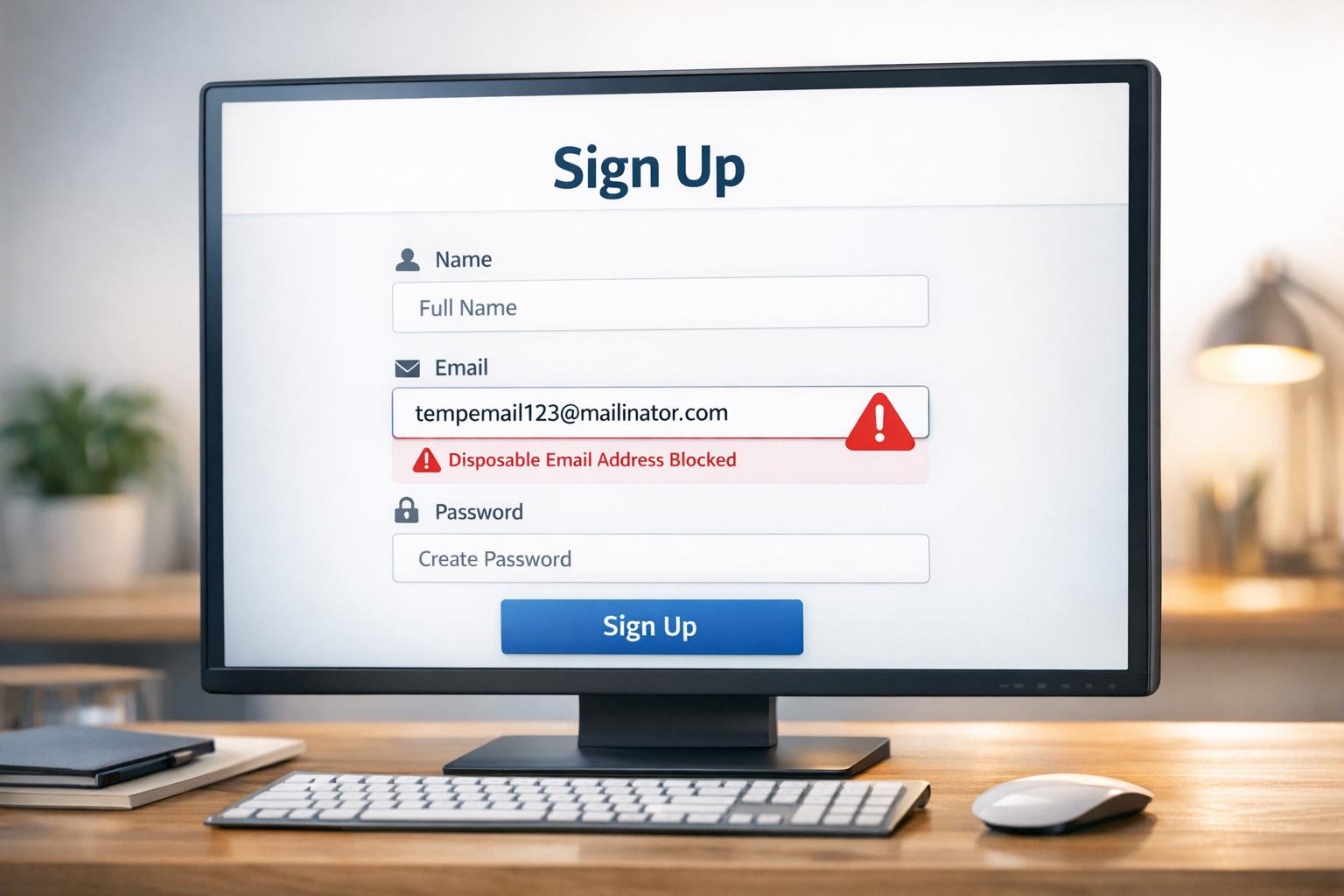
To combat this, some SaaS companies have started blocking disposable email addresses entirely. Platforms like Steam, Canny, and FastCron now display alerts prompting users to provide a different email address.
The financial toll is hard to ignore. As an analysis from istempmail.com puts it:
"Increased operational costs can hurt even more than revenue loss".
When support teams spend hours every week untangling problems caused by temporary emails, the costs add up quickly. These inefficiencies not only eat into your bottom line but also strain your operational capacity, making it harder to serve legitimate users effectively.
7. Lost Revenue and Pricing Model Problems
Temporary emails can take a serious toll on revenue. When users repeatedly exploit free trials or freemium plans using disposable email addresses, they gain access to paid features without ever converting into paying customers. As the site istempmail.com puts it:
"Revenue loss is the most important way in which companies are hurt. You are providing value that should be paid for – but users find ways to get it for free."
This issue is particularly problematic for AI-powered SaaS products. For example, in February 2025, an AI startup reported that repeated signups drained their GPU credits in just one hour. And this isn’t an isolated case - over 70% of AI companies face trial abuse on a daily basis. For businesses with usage-based billing or compute-heavy pricing models, every fake signup eats into infrastructure resources, directly impacting the budget. These losses don’t just hurt the bottom line; they also destabilize pricing and revenue models.
Temporary emails also skew your pricing strategy. Inflated user counts and misleading conversion rates can lead to poor decisions, such as unnecessary price reductions or wasted marketing budgets targeting fake accounts.
ZeroBounce COO Brian Minick highlights the broader consequences:
"Disposable emails are one of the most detrimental forms of email addresses you can have on your list for a few reasons: The email will bounce after a very short period of time (10 minutes – 24 hours). You can never contact or re-target that person again for your marketing or sales funnel."
Each disposable email in your system represents a missed chance to nurture a lead, upsell features, or re-engage a churned user. These missed opportunities can seriously hinder long-term SaaS revenue growth.
Conclusion
Temporary emails can be a silent drain on your business. They inflate costs, skew analytics, enable trial abuse, and ultimately erode revenue. By compromising data quality, wasting your team's time, harming email deliverability, and exposing your business to fraud and security risks, they create challenges that no SaaS company can afford to ignore.
To tackle these issues, a strong email validation strategy is non-negotiable. With the right tools, you can block up to 95% of fake signups. Even basic email validation can eliminate 60–70% of fraudulent accounts, while disposable email domains have a striking 95% correlation with fraud.
That’s where TempMailChecker steps in. With a constantly updated database of over 277,938 disposable domains and sub-millisecond API processing, it identifies throwaway addresses in real time. Seamlessly integrating into your signup flow, it starts at just $12 per month for production use, with a free tier for testing.
Accurate detection means your analytics reflect real user behavior, enabling smarter decisions across your product and marketing strategies. This efficiency doesn’t just save resources - it sharpens your focus. Your sales team can prioritize real leads, your support team can avoid wasting time on fake accounts, and your engineering team can concentrate on building and innovating.
Protecting your SaaS business from temporary email abuse isn’t just about cutting costs - it’s about ensuring long-term growth and profitability. Start filtering disposable emails today and focus on the users who truly matter.
FAQs
How do temporary emails affect customer acquisition costs for SaaS companies?
Temporary emails can drive up customer acquisition costs (CAC) by enabling fake signups and fraudulent activities. When marketing budgets and sales efforts are wasted on invalid leads, costs rise, and overall efficiency takes a hit.
On top of that, fake accounts created using disposable emails skew critical user metrics. This makes it more challenging to evaluate campaign performance and refine strategies effectively. Over time, these issues can sap resources and slow down authentic growth for your SaaS business.
How can SaaS companies stop free trial abuse caused by temporary emails?
To tackle the misuse of free trials by users with temporary emails, SaaS companies have a few effective tools at their disposal. Strategies like device fingerprinting can help identify unique users by tracking their devices. Adding email and phone verification ensures that only real contact information is used, while credit card verification adds another layer of accountability. Blocking disposable email domains is another straightforward way to minimize abuse. Together, these measures can protect your platform and ensure free trials are reserved for genuine users.
How do temporary emails impact email deliverability and compliance for SaaS businesses?
Temporary email addresses can hurt your SaaS platform in several ways. For starters, they often lead to higher bounce rates, which can damage your sender reputation. And when your sender reputation takes a hit, ISPs might flag your emails as spam or block them entirely. This means fewer of your messages actually reach users.
There’s also a compliance angle to consider. If your emails don’t make it to users due to temporary addresses, you could run into issues with regulations like GDPR or CAN-SPAM. Non-compliance could lead to penalties or even erode trust among your legitimate users. That’s why it’s so important to monitor and filter out disposable email addresses - to safeguard your platform’s reputation and stay on the right side of the rules.