Preventing Fake Signups: Common Challenges and Fixes
Fake signups are a costly problem for businesses. They inflate email lists, skew analytics, and waste marketing budgets. Here's the bottom line: bots and fraudsters exploit weak registration systems to abuse promotions, harm email deliverability, and drive up operational costs. By 2023, fraudulent accounts made up 9% of all new registrations, with e-commerce businesses losing billions globally to these schemes.
Key Solutions:
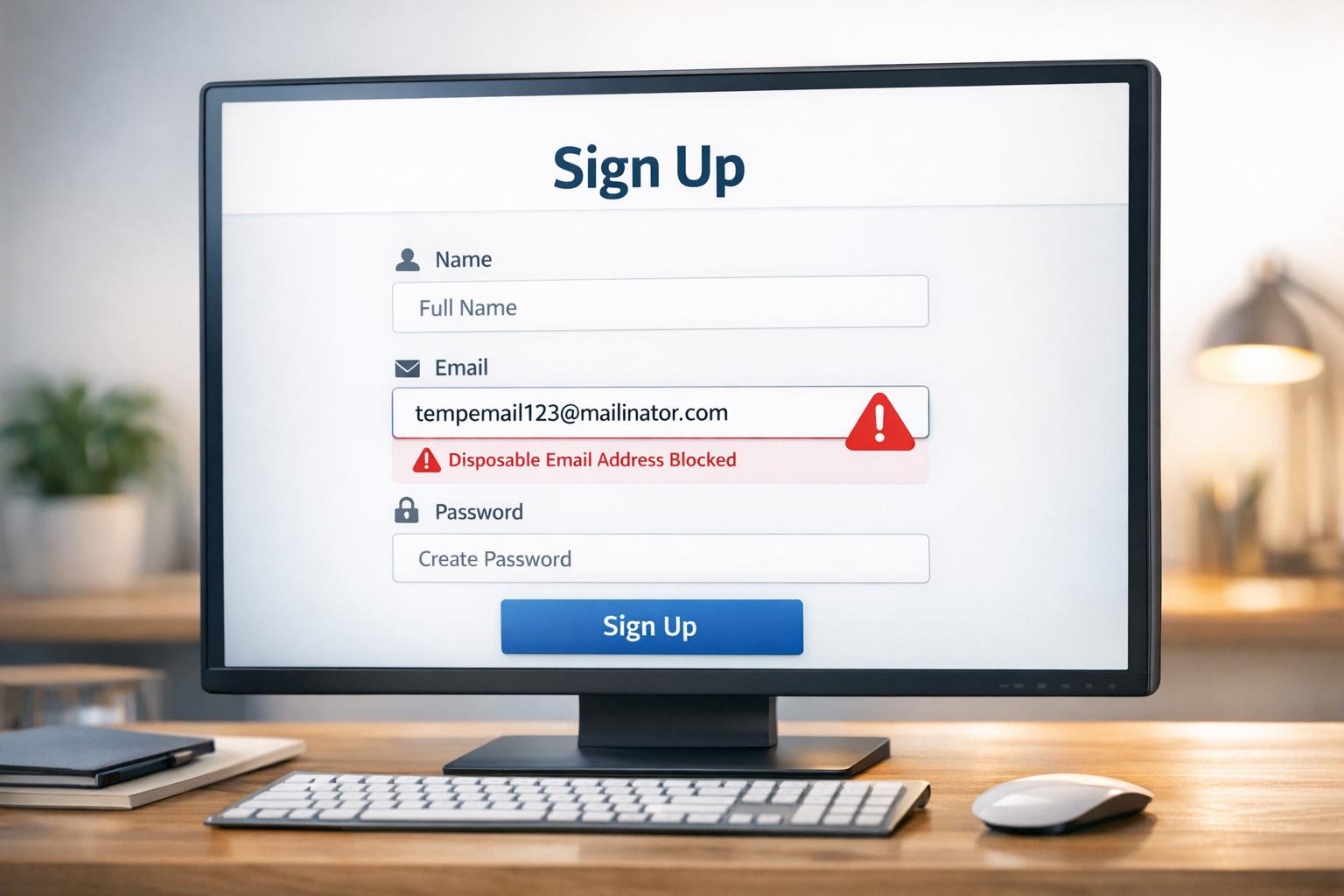
- Block Disposable Emails: Use tools like TempMailChecker to detect fake addresses in real-time.
- Strengthen Email Validation: Implement double opt-in and verify domains to ensure legitimate signups.
- Add Bot Protection: Use AI-based tools, CAPTCHAs, and honeypot fields to block automated signups.
- Limit Signup Attempts: Set rate limits and monitor IP addresses to catch suspicious activity.
- Protect Promotions: Tie rewards to verified activity and review high-risk accounts manually.
Fake signups aren't just an annoyance - they're a real financial threat. By combining email validation, bot protection, and fraud monitoring, businesses can safeguard their systems and focus on genuine users.
How To Stop People From Signing Up With Fake Email Addresses | Email Marketing Tips For Beginners
How Fake Signups Hurt Business Operations
The Financial Impact of Fake Signups on Businesses in 2023
Fake signups are more than just a nuisance - they drain resources, skew data, and rack up real costs. They impact multiple areas of a business, from marketing budgets to customer support operations. Understanding these effects is critical to defending against them. Let’s break down how fake signups affect revenue, email performance, and operational costs.
Lost Revenue from Promotion and Coupon Abuse
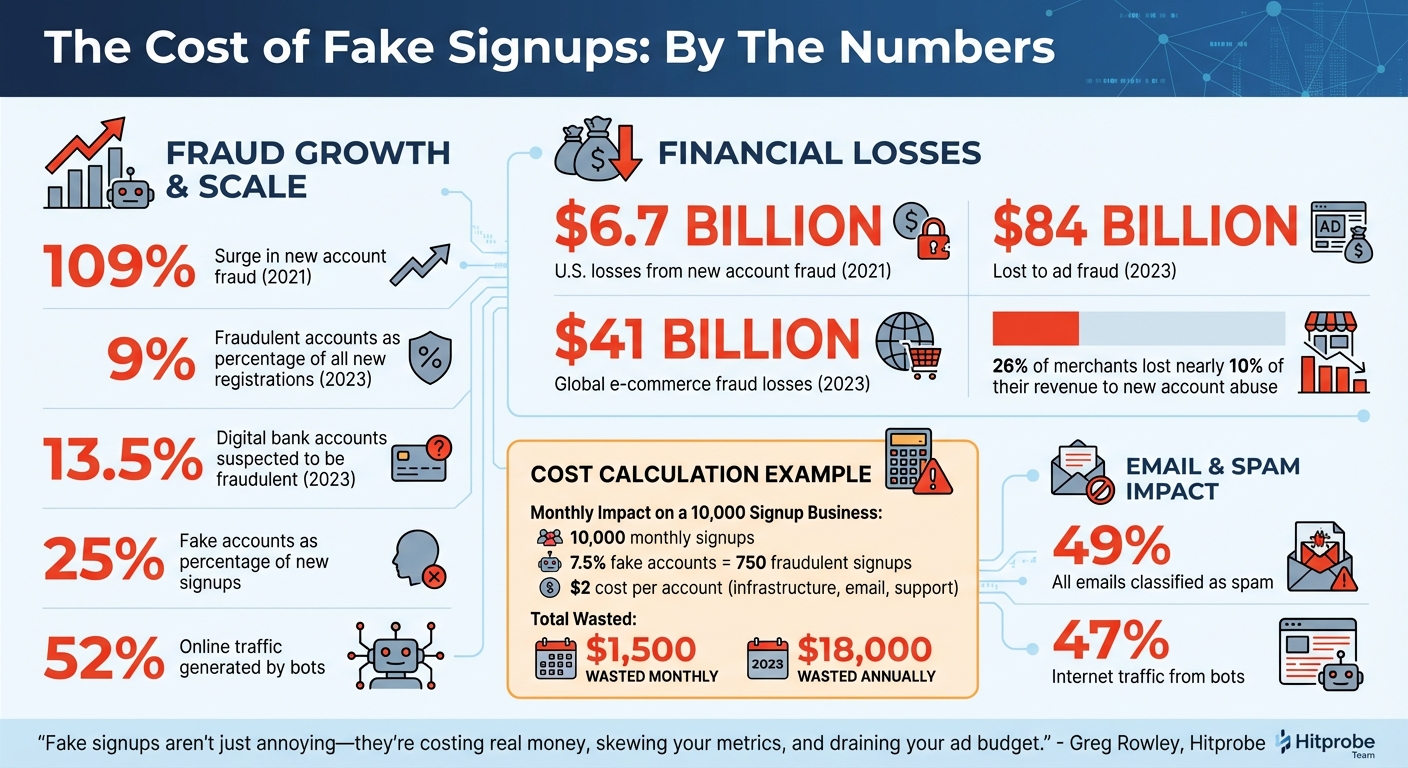
Promotional offers meant to attract legitimate customers often become a playground for fraudsters. In 2021, new account fraud surged by 109%, causing $6.7 billion in losses in the U.S. alone. According to a Forrester report from the same year, 26% of merchants reported losing nearly 10% of their revenue due to new account abuse.
Here’s how it works: fraudsters create multiple fake accounts to repeatedly claim discounts, free trials, referral bonuses, and loyalty rewards. For example, one promotional campaign offering modest benefits was quickly overwhelmed by fraudulent activity, forcing the program to shut down early due to measurable revenue losses.
Even small-scale fraud can add up. Imagine a product with 10,000 monthly signups. If 7.5% of those accounts are fake (750 accounts) and each costs $2 in infrastructure, email, support, and acquisition expenses, that’s $1,500 wasted every month. Over a year, that balloons to $18,000 in unnecessary costs. As Greg Rowley from the Hitprobe Team aptly put it:
"Fake signups aren't just annoying - they're costing real money, skewing your metrics, and draining your ad budget."
Damaged Email Deliverability and Sender Reputation
The impact of fake signups doesn’t stop at revenue loss; they also wreak havoc on email operations. When emails are sent to fake or disposable addresses, deliverability issues arise. High bounce rates, spam complaints, and low engagement signal to email service providers that your list is unreliable. This damages your sender reputation - a key factor in determining whether your emails land in inboxes or get flagged as spam.
The consequences are far-reaching. Legitimate customers may miss important messages because fake accounts have tarnished your email reputation. This reduces the effectiveness of marketing campaigns and can hurt long-term customer relationships.
Higher Operational Costs and Fraud Exposure
Fake signups also drive up costs across the board. Customer support teams waste time handling tickets from non-existent users, while development teams deal with increased server loads. Marketing budgets are drained by ad clicks that never lead to real conversions. By 2023, fraudulent new account creations made up about 9% of all new accounts, with 13.5% of digital bank accounts suspected to be fraudulent.
These fake accounts distort key metrics like customer acquisition cost (CAC) and customer lifetime value (CLTV), leading to flawed analytics and poor decision-making. Sales teams may chase leads that don’t exist, and product teams might base strategies on inaccurate data.
E-commerce platforms face even greater risks. Fraudsters exploit loyalty programs and referral systems, causing direct financial losses and driving up costs for fraud investigations and prevention measures. In 2023, global e-commerce fraud contributed to a staggering $41 billion in digital fraud, much of it tied to fake accounts gaming promotional offers. As the OnSefy Team explains:
"Fake signups are not just annoying - they're expensive, misleading, and dangerous."
The ripple effects of these inefficiencies highlight the urgent need for better fraud detection and prevention strategies.
Common Methods and Causes of Fake Signups
Understanding how fake signups occur - from automated bots to manual abuse - can help businesses protect themselves more effectively. These fraudulent activities lead to lost revenue, harm email deliverability, and drive up operational costs.
Disposable and Temporary Email Addresses
Disposable email addresses are a favorite tool for fake signups. These services provide short-term email addresses that expire quickly, allowing users to sidestep identity verification. As SrNightmare09 aptly puts it:
"Disposable email addresses are like digital ghosts - they pop up out of nowhere and vanish just as quickly. While they might serve a purpose for temporary communication, they're not exactly the go-to choice for building lasting relationships with websites." - SrNightmare09
Fraudsters use these addresses to game systems. For instance, they might extend free trials on services like Amazon Prime or Netflix or repeatedly claim new customer discounts through loyalty programs. Beyond promotional abuse, these throwaway emails are often used for posting fake reviews, committing lead fraud, hijacking accounts, and running spam campaigns.
Automated Bots and Scripted Signups
Automated bots can register thousands of fake profiles in just minutes. With bots accounting for 52% of online traffic and fake accounts making up 25% of new signups, their impact is massive.
These bots exploit weak security measures, easily bypassing basic CAPTCHAs and simplistic form validations. Once inside, they manipulate online reviews, spam users, spread misinformation, and harvest email addresses for future exploits. The cost of deploying such tactics is shockingly low - 1,000 email accounts can be bought for about $2.20 on dark web marketplaces.
Manual Fraud and Promotion Abuse
Not all fraud relies on automation. Some individuals manually create multiple accounts to exploit promotional offers, referral bonuses, or loyalty programs. These fraudsters often mimic legitimate user behavior, completing verification steps and evading basic security checks. Their motivations range from financial gain to competitive sabotage, and sometimes even malicious disruption. This contributes to a digital landscape where nearly 49% of all emails are spam.
Recognizing these tactics highlights the urgent need for stronger fraud detection and prevention measures.
Practical Solutions to Stop Fake Signups
Preventing fake signups requires a mix of smart tools and strategies, including email detection, validation, bot protection, and access controls. These methods address vulnerabilities and create a strong defense against fraudulent activity.
Use Real-Time Disposable Email Detection
Real-time disposable email detection works by verifying email addresses as users input them, blocking fake data before it even enters your system. This approach ensures a cleaner database and better engagement from legitimate users.
One tool that excels at this is TempMailChecker, which offers a high-performance API. It processes requests in sub-milliseconds and maintains an updated database of 277,938 disposable domains. This allows it to instantly identify temporary addresses often used for spam or fake signups.
As Didit highlights, "The 2025 trend is hyper-disposable email, with domains that spin up and burn down at high speed". About 46% of risky disposable domains fall into this category, making traditional blocklists ineffective against such rapidly changing threats.
Beyond stopping fake signups, disposable email detection protects your sender reputation by reducing bounce rates. Keeping your bounce rate below 2% improves email deliverability, ensuring your messages land in inboxes instead of spam folders. It also cuts down on wasted marketing spend by targeting real leads.
To complement this, stronger email validation measures can further secure your signup process.
Strengthen Email Validation and Verification
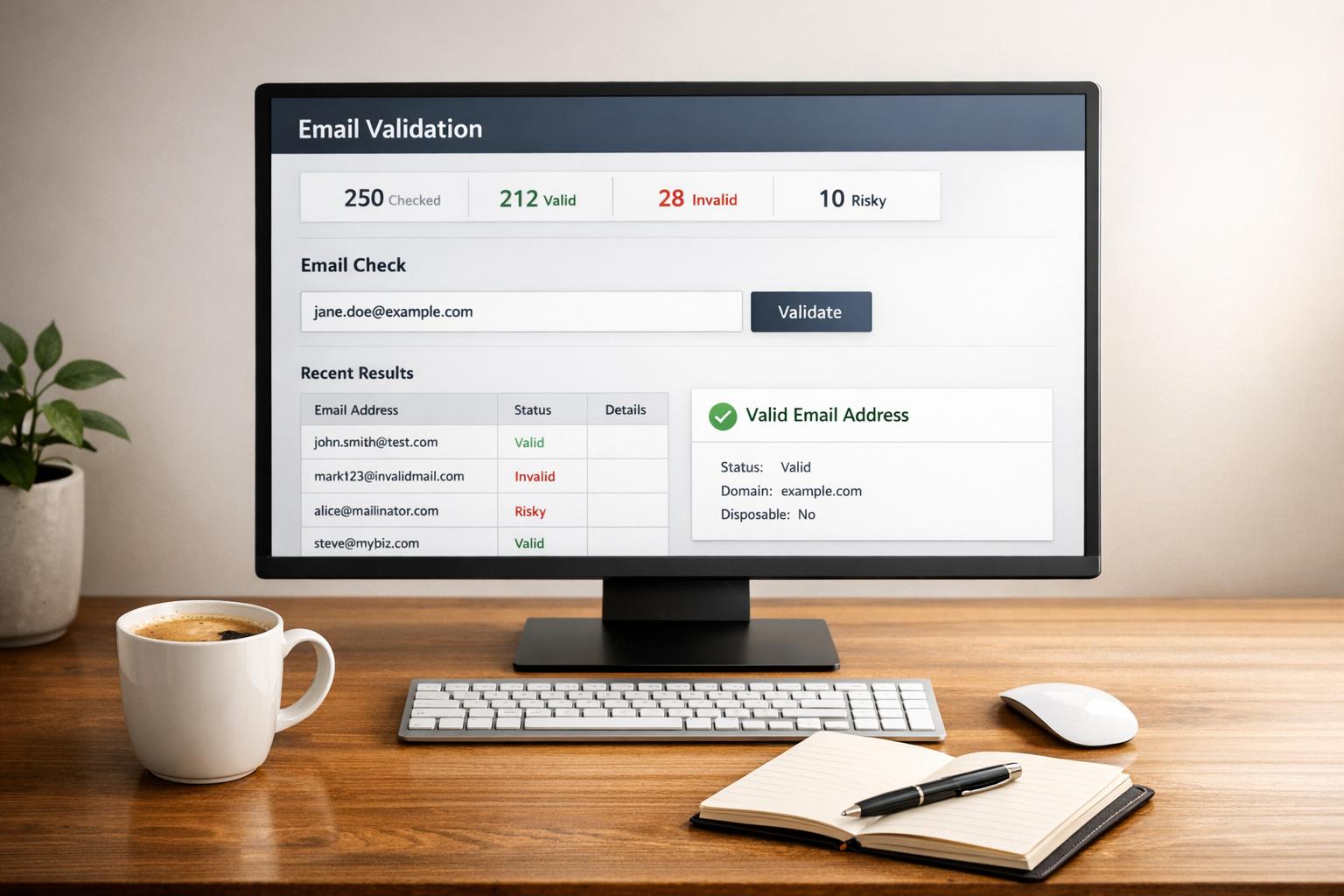
Email validation takes things a step further by ensuring the accuracy and legitimacy of email addresses. This involves checking for proper formatting (like the presence of an "@" symbol), verifying the domain’s existence, and confirming that mail servers are set up to receive messages.
Using a double opt-in system adds another layer of protection. By asking users to confirm their email address through a link, you can weed out disposable emails and confirm genuine interest. Didit notes, "OTP verification cuts multi-accounting and ATO risk from onboarding".
Regularly monitoring for unusual email patterns - such as odd domain names or high bounce rates - can also help identify disposable addresses. Maintaining and updating a custom blacklist of problematic domains is essential, as disposable email services evolve constantly.
Add Bot Protection and Form Validation
Bots are responsible for nearly 47% of all internet traffic. To combat this, AI-driven detection tools analyze hundreds of signals in milliseconds, using machine learning, behavioral analysis, and device fingerprinting to separate real users from bots.
Honeypot fields are another effective solution. These hidden fields are invisible to human users but are often completed by bots, allowing you to flag submissions as fraudulent. Pairing honeypots with modern CAPTCHAs adds another layer of security.
You can also implement multi-step signup forms. For example, requiring users to upload a profile picture or write a short bio creates an additional hurdle for bots while maintaining a smooth experience for genuine users.
Set Rate Limits and IP-Based Controls
Rate limiting restricts how many signup attempts can be made from a single IP address or device within a given timeframe. This prevents bots from flooding your system with fake registrations. By reducing fraudulent traffic, you also save resources and lower operational costs.
Analyzing IP addresses can reveal abuse patterns, such as multiple signups from the same IP or the use of proxy servers. If your service caters to specific regions, you might consider blocking signups from areas with historically high fraud rates.
Continuous monitoring is key. Watch for sudden spikes in activity, like a surge in signups during off-hours or from unexpected locations. These patterns can signal a bot attack, allowing you to take immediate action.
sbb-itb-cfbd9fd
Advanced Protection for High-Value Promotions
Promotions like referral bonuses, welcome discounts, and reward programs are often irresistible targets for fraudsters. These offers can attract organized fraud rings that exploit stolen data, automated bots, and bulk email accounts to create fake signups. For example, in October 2023, Akamai revealed how fraudsters managed to buy 1,000 Outlook email accounts for just $2.20 using services like hotmailbox.me. They even used CAPTCHA-solving tools to harvest accounts from major email platforms. These tactics can drain promotional budgets quickly, making it essential to implement strict measures to ensure these offers benefit only genuine users.
Preventing Promotion and Coupon Abuse
A solid way to protect promotions is by tying eligibility to verified account activity. For example, you could require users to make a first purchase of at least $25 or show 14 days of account activity before qualifying. Limiting one-time coupon use to accounts with validated email addresses and phone numbers adds another layer of security. Combining tools like TempMailChecker, which detects disposable emails, with SMS verification creates a strong two-layer defense. Disposable email alerts are especially useful, as they often indicate attempts at fraud. This approach can significantly reduce the appeal of promotions to fraudsters.
Risk-Based Validation and Behavioral Analysis
Keep an eye on email domain traffic for unusual patterns. Legitimate domains, such as Gmail, tend to show consistent behavior with daytime activity peaks and nighttime dips. However, disposable domains like cantuenza1.com or cpzmars.com often exhibit short, erratic traffic spikes, signaling bot-driven attacks.
Watch for high-risk signals like multiple registrations from the same IP address, the use of proxy servers, or oddly formatted email addresses such as "jklmno1234@gmail.com". Stripe Radar's AI models provide a great example of this layered approach: advanced fraud detection can boost accuracy by 36%, with IP addresses contributing 12%, customer emails 11%, and billing addresses 1%. As fraud evolves, attacks are becoming less frequent but more sophisticated, often involving AI-generated fake identities and content. Behavioral analysis is critical for staying ahead of these increasingly complex threats and protecting promotional integrity.
Reviewing and Quarantining High-Risk Accounts
Once high-risk indicators are flagged, it’s crucial to review suspicious accounts carefully. Queue these accounts for manual checks before granting them full access. For instance, accounts with disposable emails or those created in rapid succession could be subjected to additional SMS verification before they can access promotional offers.
Set fraud score thresholds based on your level of risk tolerance. For high approval rates, block accounts with fraud scores above 75. For a balanced approach, use a threshold of 50. If maximum protection is your priority, block accounts scoring above 25. Adjusting these thresholds during critical promotional periods helps maintain a balance between security and smooth operations without causing unnecessary disruptions.
Monitor and Improve Fraud Prevention Over Time
Fraud prevention isn't a one-and-done task - it requires constant vigilance and adaptation. With a staggering 73% of internet traffic coming from malicious bot farms and $84 billion lost to ad fraud in 2023 alone, staying ahead of evolving tactics is critical. Continuous monitoring and refinement are essential to keeping your systems effective.
Track Key Metrics and Adjust Detection Rules
As fraud methods evolve, keeping an eye on key metrics allows you to respond quickly to new threats. Start by monitoring bounce rates, which can reveal fake signups tied to non-existent email addresses. Keep tabs on the number of blocked signups each week to evaluate how well your system is working. Watch for unusual spikes in coupon redemptions from new accounts, as this often signals coordinated fraudulent activity.
Email engagement metrics, like open rates and click-through rates, can also provide valuable insights. Real users tend to boost these numbers, while fake accounts drag them down. Similarly, tracking conversion rates - from signup to first purchase - can highlight suspicious behavior. For instance, a high volume of website clicks paired with low conversions may point to bot activity. Pay attention to large-scale new account creations, especially when they follow unusual patterns or come from questionable sources. Unlike human users, bots often interact with websites at lightning speed, which can be a red flag.
Use Feedback Loops for Continuous Improvement
A robust feedback loop is key to refining your fraud prevention systems. For example, confirmed cases of fraud should be flagged and used to update detection rules. Tools like TempMailChecker can help fine-tune validation thresholds. Platforms like Stripe even allow businesses to mark transactions as "Refund as fraud" directly from their Dashboard, feeding this data into their Radar AI models to improve detection.
If your system is blocking too many legitimate users, consider loosening your fraud score thresholds. On the flip side, if fraudulent accounts are sneaking through, tighten your rules. A manual review queue for borderline cases can offer valuable insights, helping you fine-tune automated systems. Set up alerts to notify you of sudden spikes or sustained increases in fraud rates, enabling you to act quickly when new threats emerge. These ongoing adjustments not only improve detection but also help align your practices with regulatory requirements.
Maintain Compliance with Privacy and Anti-Spam Laws
Effective fraud prevention must strike a balance with user privacy. Comply with regulations like CAN-SPAM, GDPR, and CCPA, and integrate privacy by design into your systems. This means collecting only the data necessary for validation and ensuring you have explicit user consent where required.
Document your data policies clearly and conduct regular impact assessments, particularly for AI-driven detection tools. With nearly half of all emails (49%) classified as spam, maintaining a clean email list and a strong sender reputation is critical. Fraud prevention measures should be transparent and fair, designed to block fake accounts without overstepping privacy boundaries or discriminating against legitimate users.
Conclusion
Fake signups can take a serious toll on your business. They harm your sender reputation, inflate your email lists, and waste valuable resources. For example, promotional abuse can quickly eat into your marketing budget, while bloated email lists lead to unnecessary costs when email service providers charge based on subscriber numbers.
To combat these challenges, it’s essential to adopt strong fraud prevention measures. Blocking disposable email addresses, using bot protection tools, and regularly monitoring key metrics help ensure your marketing efforts reach real customers. These steps not only safeguard your campaigns but also protect your brand’s integrity.
A solution like TempMailChecker is designed specifically to tackle disposable email abuse. With a database of over 277,938 disposable domains and lightning-fast processing speeds, it can identify and block throwaway email addresses during the signup process. This stops spam bots in their tracks and keeps your subscriber list clean and reliable.
Maintaining a high-quality email list does more than just protect your sender reputation. It keeps your emails out of spam folders, ensures accurate marketing metrics, and helps you avoid account suspensions. Most importantly, it builds trust with your audience by focusing on genuine, engaged users.
Start by implementing real-time detection for disposable emails, robust validation systems, and rate limiting. Then, refine your approach using key metrics to cut costs and strengthen customer relationships. Staying proactive and vigilant is the key to long-term success.
FAQs
How can businesses identify and prevent fake signups using disposable email addresses?
Disposable email addresses are short-lived inboxes often used to dodge verification, grab limited-time promotions, or create fake accounts. To tackle these effectively, businesses can take a few proactive steps:
- Implement a real-time API: This allows you to instantly identify disposable email domains during signups, keeping your database clean without disrupting the user experience.
- Keep a regularly updated blocklist: A continuously refreshed list of known disposable email domains helps you stay ahead of newly emerging providers.
- Layer additional security measures: Pair email detection with tools like IP reputation checks, CAPTCHA, or phone verification to strengthen your defenses against fraud.
Incorporating these strategies into your registration process can help filter out fake accounts and maintain a more trustworthy user base.
How do fake signups affect email deliverability and sender reputation?
Fake signups can wreak havoc on your email deliverability and sender reputation. When your campaigns end up targeting invalid or disposable email addresses, your bounce rates skyrocket, and key engagement metrics - like open and click-through rates - take a hit. Email providers interpret this as poor list management, which can lead to serious consequences like your emails landing in spam folders, being throttled, or, worse, getting completely blocked.
On top of that, sending emails to throwaway or spam-heavy domains increases the risk of spam complaints or even blacklisting your IP or domain. This not only damages your reputation but also makes it much harder for genuine emails to reach real users. To avoid these pitfalls, consider using tools like real-time disposable email detection. These tools help block fake signups, ensuring your email list stays clean and your campaigns avoid deliverability issues.
Why is bot protection and rate limiting important for signup forms?
Bot protection and rate limiting play a crucial role in safeguarding the integrity of your signup process. Automated registrations can clutter your user database with fake accounts, distort your analytics, and drain resources on leads that don’t actually exist. On top of that, bots can exploit offers like discounts or referral bonuses, causing unnecessary financial losses.
If left unchecked, malicious bots can also overwhelm your servers, slowing down your site and frustrating real users. Rate limiting addresses this by restricting how many requests a single user or IP can make within a set timeframe. Meanwhile, tools like CAPTCHAs and disposable-email detection systems (such as TempMailChecker) analyze each signup attempt in real time to block suspicious activity.
These measures not only help maintain accurate data and protect your budget but also ensure a smooth experience for legitimate users.