What Is Email Domain Risk Scoring?
Email domain risk scoring is a method to evaluate the likelihood of an email address or domain being tied to fraudulent activities. Unlike basic validation, which checks if an email can receive messages, this approach analyzes deeper factors like domain reputation, age, history, and potential misuse. Scores range from 0 (low risk) to 100 (high risk), helping businesses identify and block risky users.
Key Points:
- Purpose: Detect fraud, block disposable emails, and prevent fake registrations.
- How It Works: Uses machine learning and data analysis (e.g., domain age, MX records, IP reputation).
- Why It Matters: Email fraud contributes to 46% of account takeovers. Scoring improves fraud detection by 35-45%.
- Actionable Scores:
- 75–100: Block immediately.
- 50–74: Review or apply extra verification.
- 0–49: Likely safe.
By implementing domain risk scoring, businesses can protect their platforms, reduce fraud, and maintain clean email lists.
How Email Domain Risk Scoring Works
Core Concepts Behind Risk Scoring
Risk scoring systems rely on a combination of weighted models and machine learning to evaluate potential threats. Weighted models assign points for specific failures - like missing MX records or suspicious top-level domains (TLDs) - while machine learning analyzes multiple predictors to assess risk levels.
Scores are typically normalized on a 0 to 100 scale, where 0 indicates no detected issues and 100 reflects confirmed malicious activity. Some systems allocate different weights to various factors: for instance, email and domain attributes might each account for 30% of the score, IP addresses 20%, and user agents 10%.
To streamline the process, many systems use short-circuiting logic. This means high-severity failures - like invalid domain syntax or unregistered domains - automatically flag an email as high-risk without further analysis. These scoring models rely on a wide range of data inputs, which are detailed in the next section.
Data Sources and Signals Used in Scoring
Risk scoring engines gather information from multiple sources to create detailed profiles. Disposable domain databases, such as TempMailChecker, monitor over 277,000 temporary email providers in real-time, enhancing the detection of disposable emails. DNS and infrastructure signals analyze factors like MX records, domain age (via WHOIS lookups), and the reputation of name servers hosting the domain.
IP reputation and blocklists are critical for identifying spam-related activity. DNS-based Blackhole Lists (DNSBLs) track IPs linked to spam, compromised systems, or botnets. Advanced systems also use OSINT (open-source intelligence) to verify email links against active profiles on platforms like Google or LinkedIn, ensuring consistency in names and locations.
SMTP verification checks whether a mailbox exists by contacting the mail server in real time. Historical data, such as confirmed chargebacks, fake signups, or activity from compromised devices, is also factored into scoring. Additionally, data breach aggregation examines whether an email appears in known breaches. A moderate breach history may indicate legitimacy, whereas none or excessive breaches could signal risk.
| Data Source Category | Specific Signals Collected | Collection Method |
|---|---|---|
| Domain Registry | Domain age, TLD, Registrar reputation | WHOIS lookups and registrar database monitoring |
| Network Infrastructure | ASN reputation, TLS certificate status, Name Server | Active scanning and crawling infrastructure |
| Email Content/Tokens | Cryptographic hashes of email addresses, URLs | Automated analysis of spam traps and SMTP traffic |
| User Behavior | Online velocity, purchase history | OSINT gathering and cross-platform footprinting |
| IP Intelligence | Residential vs. Data Center IP, Proxy/VPN detection | Monitoring of dynamic IP space and known exit nodes |
These signals are used to calculate risk scores, which are then categorized into structured bands for decision-making.
How to Read and Use Risk Scores
Risk scores are divided into four bands, each offering guidance for action. Malicious scores (75-100) indicate confirmed links to malicious infrastructure or blocklists and should prompt automatic blocking. Suspicious scores (50-74) suggest possible connections to risky infrastructure and may require manual review or additional verification, such as multi-factor authentication (MFA). Neutral scores (25-49) meet at least two risk criteria and warrant further investigation before approval. Low or unknown scores (0-24) show no significant risks and can generally be approved without concern.
To enhance fraud prevention, thresholds should align with your organization's security needs. For example, a financial services platform might block scores above 75 automatically, manually review scores between 50 and 74, and approve scores below 50. In contrast, e-commerce platforms with lower fraud risks might adopt more lenient thresholds to avoid rejecting legitimate customers.
Many scoring tools also provide reason codes alongside numeric scores. These codes - like "domain_fresh" or "email_local_high_entropy" - explain why a domain was flagged. This feature helps teams make informed decisions during manual reviews and stay ahead of emerging fraud patterns.
Why Domain Risk Scoring Matters for Detecting Disposable Emails
How Disposable Email Domains Damage Businesses
Disposable email addresses might seem harmless at first glance, but they can wreak havoc on businesses in several ways. They open the door to promo abuse, allowing users to create unlimited accounts to exploit coupons, credits, or trial periods. On top of that, these emails hurt deliverability. Since temporary inboxes expire quickly, bounce rates spike, which can damage your sender reputation.
Then there’s the issue of inflated metrics. Disposable emails can make your Monthly Active User (MAU) count look healthy, but in reality, server resources are being wasted on accounts that will never convert. And let’s not forget the strain on customer support - when users lose access to these temporary accounts, they flood your team with password-reset requests.
"If you don't block disposable emails, your signup flow will still get abused... Mailinator, GuerrillaMail, Temp-Mail, 10MinuteMail → infinite trial accounts, fake signups, coupon abuse, spam accounts." – Tobias Jansen
The problem doesn’t stop there. High-risk email domains are often linked to fraudulent payments and chargebacks. In fact, email address fraud enables nearly half (46%) of account takeover incidents. Domain risk scoring steps in as a proactive measure, blocking these problematic domains before they can disrupt your operations.
Benefits of Domain Risk Scoring
Domain risk scoring offers a powerful way to stop high-risk domains before they infiltrate your system. By validating emails during registration, checkout, or coupon redemption, you can block abusive users at the source. Advanced email risk scoring has been shown to outperform traditional verification methods by 35% to 45% in detection rates.
This technology processes data on an enormous scale - analyzing over 1 billion user actions daily and identifying around 5,000 new blacklisted emails every second. Unlike outdated static lists that lose accuracy within a day, domain risk scoring provides real-time intelligence to keep your database clean and your marketing metrics reliable. It’s a game-changer for maintaining accurate lead generation data and protecting your return on investment.
How TempMailChecker Detects Disposable Emails
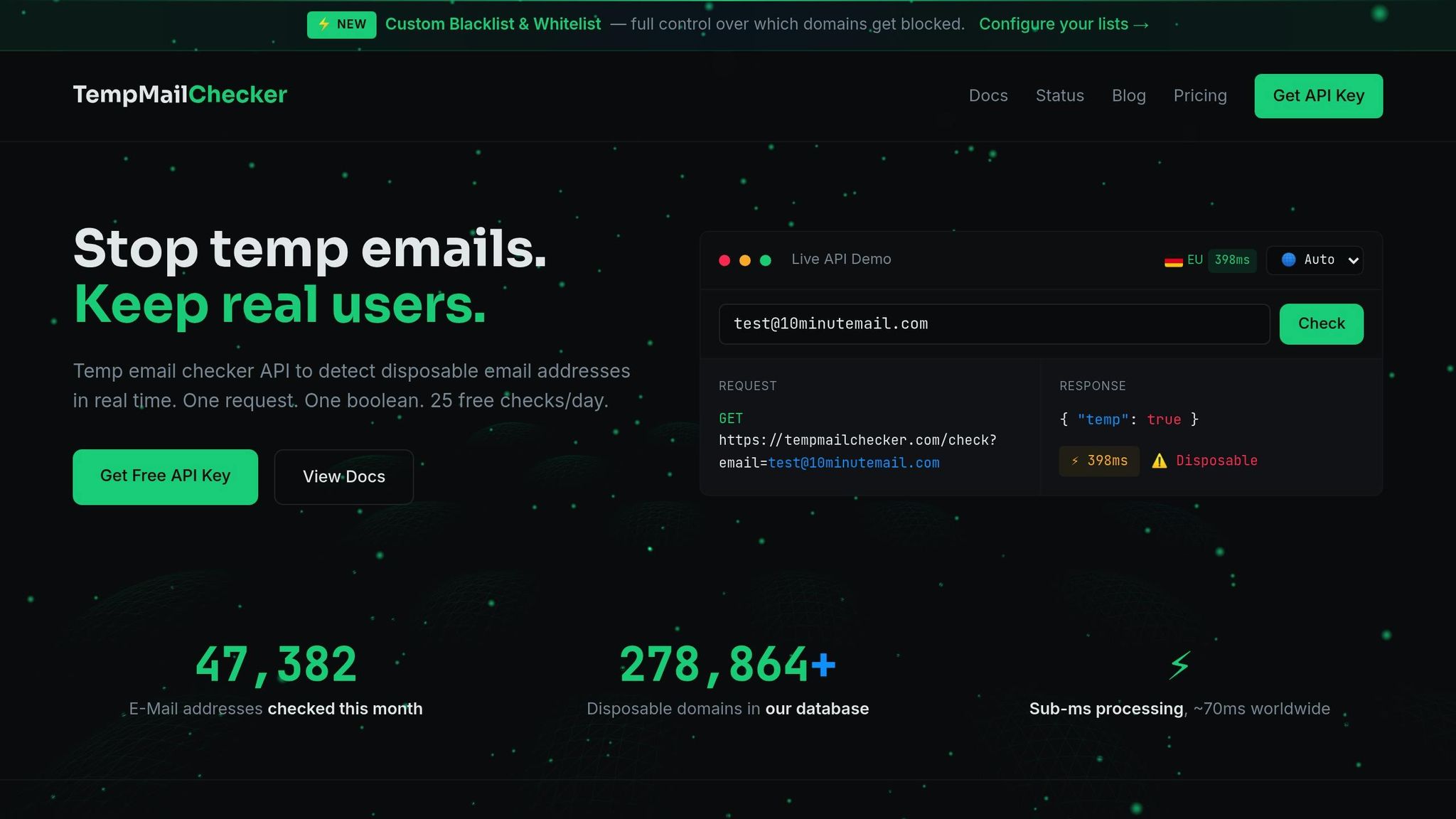
TempMailChecker is a specialized tool that stays ahead of disposable email threats by maintaining a database of over 277,938 disposable email domains, updated daily. Its API processes requests incredibly quickly, with response times averaging just ~70ms through regional endpoints in the U.S., EU, and Asia. The service delivers a simple JSON response - just a clear true/false answer to indicate whether an email is disposable. This straightforward approach makes it easy to integrate into signup forms, waitlists, or promotional pages, rejecting risky addresses in real time.
"Disposable email domains don't follow patterns. Regex cannot catch them." – Tobias Jansen
TempMailChecker even offers a free tier with 25 daily requests (no credit card required), perfect for testing before full deployment. Paid plans start at just $12 per month for 3,000 requests, scaling up to accommodate businesses handling tens of thousands of validations monthly. By delivering fast, accurate results, TempMailChecker strengthens the broader framework of email domain risk scoring, helping businesses stay one step ahead of fraud.
What Tools Can Check My Domain Reputation? - TheEmailToolbox.com
sbb-itb-cfbd9fd
How to Implement Email Domain Risk Scoring
Email Domain Risk Score Ranges and Recommended Actions
Implementation Steps
Start by extracting the domain from user email addresses during registration, login, or checkout. Submit this domain to a REST API that provides risk signals like "disposable" or "recent_abuse" and assigns a fraud score.
The API request is simple to configure. Key parameters include "timeout" (sets the wait time for SMTP checks), "fast" (bypasses SMTP verification for quicker responses), and "strictness" (adjusts the sensitivity of machine learning detection). If accuracy is a priority over speed, choose timeouts between 20–40 seconds. For faster responses, a 7-second timeout can be used, though it may result in a "timed_out" response.
Act on the API results immediately. Emails flagged as disposable or associated with recent abuse should be rejected outright, regardless of the score. For fraud scores, treat those above 75 as suspicious and anything between 90–100 as high-risk. Always use the "sanitized_email" provided by the API to avoid duplicates caused by aliases.
Setting Risk Thresholds for Different Use Cases
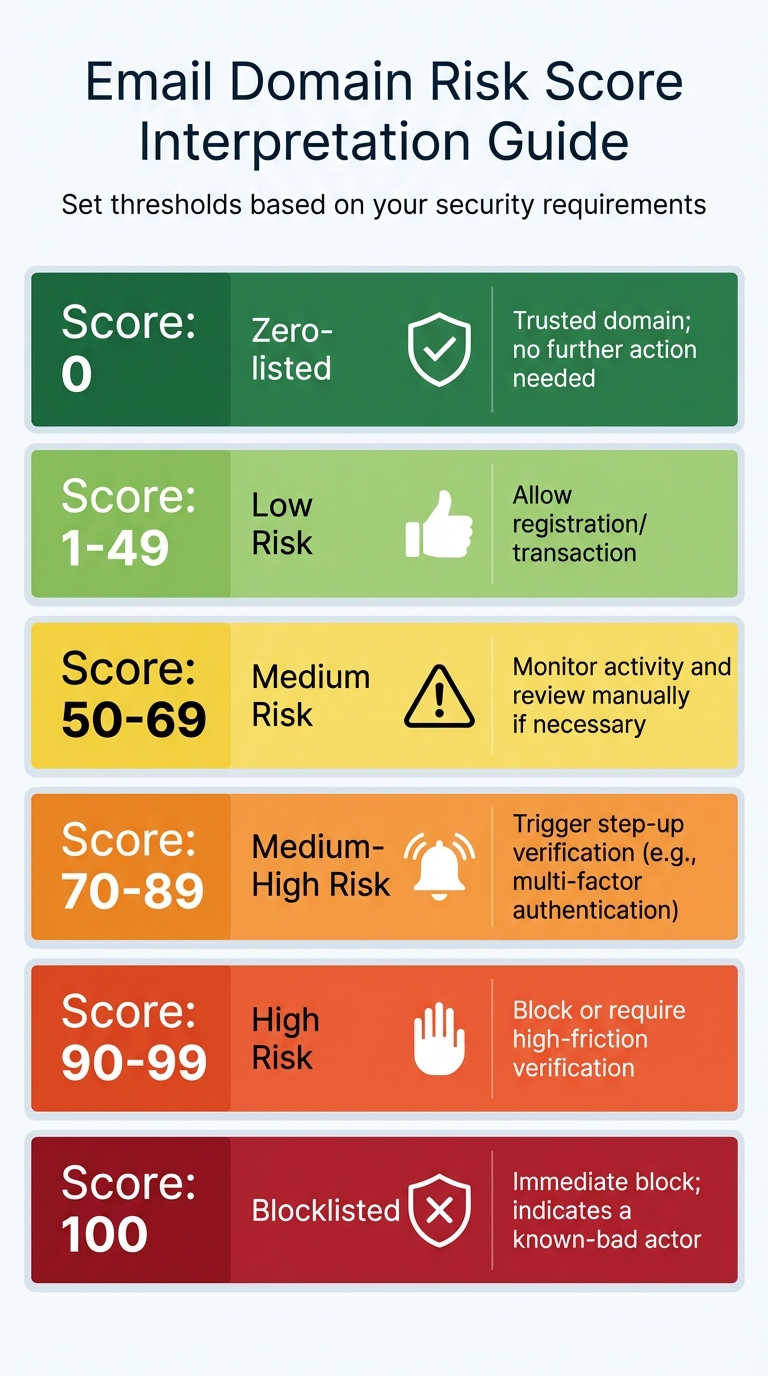
Risk thresholds need to align with the security requirements of your specific scenarios. For high-risk situations, such as e-commerce transactions, block emails with scores in the 90–100 range and require additional verification (like multi-factor authentication) for scores in the 70–89 range. For lower-risk scenarios, such as basic signups, you might only flag or block emails with higher scores to minimize user friction.
Here’s a table summarizing suggested actions based on risk scores:
| Score Range | Risk Level | Recommended Action |
|---|---|---|
| 100 | Blocklisted | Immediate block; indicates a known-bad actor |
| 90–99 | High Risk | Block or require high-friction verification |
| 70–89 | Medium-High Risk | Trigger step-up verification (e.g., multi-factor authentication) |
| 50–69 | Medium Risk | Monitor activity and review manually if necessary |
| 1–49 | Low Risk | Allow registration/transaction |
| 0 | Zero-listed | Trusted domain; no further action needed |
Once these thresholds are in place, keep monitoring the system to ensure it provides the right level of protection.
Monitoring and Adjusting Your System
After setting your risk thresholds, ongoing monitoring is essential to strike the right balance between fraud prevention and user accessibility. Track false positives and negatives through user feedback and blocked registrations. If legitimate users are being rejected too often, consider lowering the strictness parameter or revising your thresholds. On the other hand, if fraudulent accounts are slipping through, raising the strictness level (typically set between 0 and 3) can help detect more advanced threats, though it might also increase false positives.
If lookups are causing delays, increase the timeout settings. Use services that frequently update their disposable domain blocklists - some even refresh several times an hour to catch new temporary email providers.
Also, monitor for patterns that indicate coordinated attacks, like email tumbling or rapid signups from specific domains. Adjust the signal weights periodically to address these threats. Some providers analyze over 1 billion actions daily, leveraging consortium data and feedback loops to refine their fraud detection models.
Best Practices for Using Domain Risk Scoring
Do's and Don'ts for Handling Risky Domains
Do: When dealing with borderline cases, consider triggering a one-time passcode or an identity check instead of outright blocking the domain. This approach maintains a balance between security and user experience, as legitimate domains can occasionally be misclassified.
Don't: Avoid relying solely on basic syntax checks. Advanced scoring methods should be implemented to identify catch-all domains (those that accept emails regardless of mailbox validity), nonsensical email handles, and known spam traps.
Do: Leverage the reason codes provided by your risk scoring API to understand why a domain was flagged. These codes might indicate issues like domain age, typing distance, or mismatches between the email handle and the associated name. Store these reason codes alongside the risk score in your database to create an audit trail, allowing you to assess the underlying factors instead of treating all high scores the same.
Do: Keep an eye on your sender reputation when applying domain risk scoring for outbound emails. Providers like Google and Yahoo expect bulk senders to maintain a spam complaint rate below 0.1%. Exceeding 0.3% can harm your reputation. Use tools like a deliverability leaderboard to identify campaigns that may trigger high-risk signals before they negatively impact your domain standing.
Documenting Risk Decisions and Escalation Procedures
To ensure consistent handling of risky domains, document all risk-related decisions. Define clear thresholds for risk scores and outline corresponding actions, such as immediate blocking, step-up verification, or manual review. This documentation creates a solid audit trail and simplifies dispute resolution.
Include metadata (up to 4KB) with each risk check request to link scores to specific user or transaction IDs. This allows you to tie every decision to an internal record, making it easier to audit actions or spot patterns in coordinated attacks. If a legitimate domain is misclassified, escalate it to a "Safe Senders List" or internal whitelist to bypass future checks.
Track technical authentication signals like SPF, DKIM, and DMARC statuses on an hourly basis, and document these parameters to address drops in domain reputation. As email expert Amanda DeLuke puts it:
"Authentication is foundational".
Without proper documentation, identifying the root cause of a reputation decline can become a daunting task.
Establish a feedback loop using tools such as Google Postmaster Tools to monitor manual spam reports. Interestingly, about 69% of recipients mark emails as spam solely based on the subject line. Tracking these trends can help you refine internal risk thresholds and improve email practices over time.
Combining Domain Risk Scores with Other Risk Signals
Domain risk scores are most effective when used alongside other fraud indicators, such as IP address analysis, device intelligence, and behavioral patterns. Create a weighted model where email and domain signals carry more weight compared to factors like IP addresses or user agents.
Ensure consistency across multiple data points. For example, verify that a user's IP location aligns with the country associated with their email's online activity, or that the provided name matches social profiles linked to the email address. Keeping an eye on usage trends can also help detect coordinated attacks, such as email tumbling.
To optimize your system, configure it to immediately block requests that fail critical checks - like unregistered domains, invalid email syntax (per RFC 5322), or known Tor exit nodes. This prevents unnecessary resource usage on fraudulent attempts.
Since email lists naturally degrade by about 22.5% annually, combine domain risk scoring with regular list cleaning. This helps you avoid spam traps and maintain the effectiveness of your validation process. As Amanda DeLuke emphasizes:
"It's all about that reputation with the human on the other side".
A well-rounded fraud prevention system doesn’t just focus on the domain. It evaluates how the domain interacts with other risk signals, ensuring a stronger and more reliable email validation process.
Conclusion
Email domain risk scoring plays a key role in safeguarding platforms from fraud. With email address fraud contributing to 46% of account takeover incidents, relying solely on basic syntax checks or deliverability tests just doesn’t cut it anymore. Advanced systems now evaluate over 30 data points - like domain age, MX records, abuse history, and leaked credentials - to spot disposable emails, coordinated fraud attempts, and other high-risk behaviors.
These advanced tools can outperform standard verification methods by an impressive 35-45%, all while keeping costs as low as $0.0003 per request. Considering that email lists degrade by 22.5% annually, maintaining clean and secure email lists is not only effective but also cost-efficient.
TempMailChecker provides real-time, low-latency protection powered by a constantly updated disposable domain database. Its simple JSON response easily integrates into registration forms, checkout pages, and account verification processes, blocking fraudulent signups right at the source.
For even stronger fraud prevention, combine domain risk scores with other fraud indicators to fine-tune your security measures. For instance, you could block emails with risk scores above 90 and flag those scoring between 75 and 90 for manual review. Document these decisions, monitor authentication signals like SPF and DKIM, and adjust thresholds based on ongoing feedback. This layered approach not only protects transactions but also enhances your platform’s reliability.
FAQs
What is email domain risk scoring, and how does it enhance fraud detection?
Email domain risk scoring takes email validation to the next level by assigning a risk score to evaluate how trustworthy an email domain is. While basic validation only checks for things like syntax or server records, this method digs deeper. It looks at factors such as domain reputation, past instances of abuse, and machine-learning insights. This makes it possible to spot disposable or suspicious domains in real time.
By analyzing data like domain age, deliverability history, and abuse reports, email domain risk scoring helps businesses catch fraudulent accounts, stop fake signups, and cut down on spam. Tools like TempMailChecker use these insights to deliver instant and precise risk evaluations, allowing companies to fight fraud and make better decisions - all without disrupting the user experience.
What makes an email domain high-risk?
An email domain is flagged as high-risk when it shows certain warning signs. These can include high complaint rates, frequent bouncebacks, and spam-trap hits, all of which suggest poor email practices. Additional indicators might be low engagement metrics, such as weak open or click-through rates, sudden surges in email volume, missing or inadequate sender authentication, and the presence of disposable or temporary email domains.
Spotting these risky domains is essential to safeguarding email security and avoiding problems like spam, fraudulent activity, or fake signups. Tools like TempMailChecker are designed to identify disposable email domains in real-time, helping keep your platform secure and running smoothly.
How can businesses use email domain risk scoring to block disposable email addresses?
Email domain risk scoring allows businesses to assess the reputation of an email's domain and identify disposable or potentially risky addresses in real time. Disposable emails are often tied to fraudulent activities like fake signups, spam, or credential abuse. By assigning a risk score to each domain, businesses can quickly decide whether to block or flag suspicious addresses.
To make this process seamless, businesses can integrate TempMailChecker’s high-performance API into their systems, such as sign-up forms or transaction workflows. The API delivers a straightforward JSON response that includes a domain risk score and a disposable address flag. With processing speeds measured in sub-milliseconds, it ensures smooth user interactions while filtering out temporary or suspicious emails.
Here’s how it works:
- Evaluate email domains as users input their information, capturing the associated risk score in real time.
- Establish thresholds to automatically block high-risk addresses or flag borderline cases for further review.
- Automate responses, such as rejecting disposable emails outright or triggering verification challenges for questionable entries.
By leveraging email domain risk scoring, businesses in the U.S. can cut down on fraud, minimize spam, and build a more reliable user base - all without compromising the customer experience.